


I.
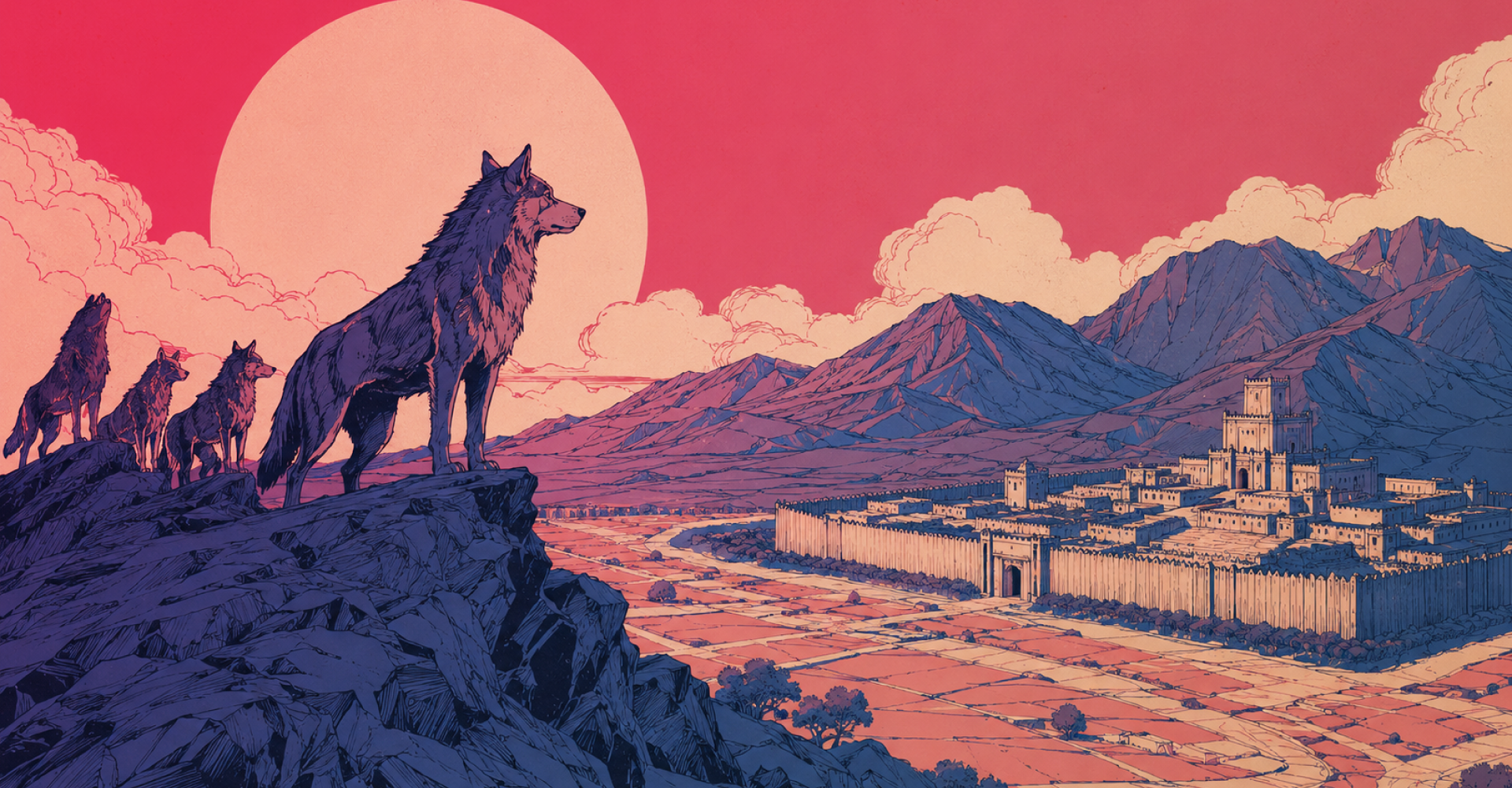
Every political order begins with a group that has decided not to flee. It is the impossibility of flight that drives the competitive demarcation of space. Territory is the name given to the space that emerges when a group decides to contend for it. The emergence of territory is the most archaic of all political acts: it is the most intimate because it is the most concrete; it is the origin of every law, every norm. It is the gesture that makes all survival possible, because it creates the space without which the group cannot exist. Without it, there is no asabiyyah—the disposition to fight for the group, to act in concert when external violence threatens the destruction of the individual element. According to Ibn Khaldun, it is asabiyyah that converts a mere aggregate of individuals into a real political unit; that is, it enables the group to fight for its survival in a given territory. Scarcity, then—badawa, harshness—is what produces asabiyyah. Under asabiyyah, everyone’s survival depends on everyone’s loyalty. It would not be an exaggeration to say that asabiyyah is more than a sociological phenomenon: it is a technique of combat and survival. It is a specific and singular way of organizing perception and action. What it forms is a horde, meute—a pack. The pack is the oldest and most powerful form of human organization. Packs organize small numbers of excellent individuals and bring them into harmony around an immediate goal—predatory, existential, belligerent. It is no accident that the pack distinguishes itself from and prevails over the weakest and sickliest form of grouping: the herd. The density of agency within the pack—that is, its capacity to mobilize collective energy effectively and precisely—is what ontologically distinguishes it from the mass. The mass has numbers; the horde has resolve.
Deleuze and Guattari were the first to grasp the dynamism of the horde as an organizational form. As a primitive territorial machine, it inscribes, organizes, marks, and fights for a land in pursuit of a project of power or collective organization. Unlike the herd’s inertial expenditure, the horde performs a direct and effective coding: it organizes and intensifies its flow—a flow of force, of power. As we have said, the horde is a formation that transforms raw space into territory; and if the emergence of the socius depends on the territorial inscription of the nomos—the nomos of the land—it is because every nomos is already a nemein: a taking, organizing, dividing, distributing. This is the origin and reason for the founding of cities. Every city arises as a receptacle of energy. It is less a marketplace than a palisade, less a square than a citadel. The city is a territorial machine that amplifies the horde’s human capacity. It “stores” the discipline and knowledge the horde developed in its mobile life. The city’s territorial inscription is a particle accelerator: it accumulates, concentrates, and processes social tension with precision. As Lewis Mumford argues, the king [the leader of the horde] was the first chief engineer to fuse military discipline with technical and strategic planning. The citadel is the first receptacle of the urbs. It brings together the functions of command and surplus storage. Once settled, the hunting horde becomes the vanguard that projects onto physical space an order that had previously existed only in its will to dominate. Through its own concentration of energy, the city multiplies the effectiveness of human effort; what was once a band becomes a high-pressure nucleus capable of transforming its physical environment through the precise coordination of its human contingent. That is why a horde does not merely use its own strengths and abilities; it also has the properties of matter at its disposal as an exploitable resource. Having taken a territory, the horde inscribes its image upon it: the image of its will. It maps onto that space the resources and strategic zones of its project of power.
Alan Testart was the first to identify that the availability of material resources—whether bodily or physical—does not, by itself, maximize a group’s capacity for action; in other words, its stock of power. Only the management of its human stock and the ability to mobilize physical resources through organized collective action can catalyze that physical stock and convert it into usable energy for the evolutionary propulsion of culture. The tendency Testart identified in certain pre-state societies—their inability to make evolutionary leaps because of the disorganization and mismanagement of their physical stock, leading to stagnation and vulnerability—can help explain a significant part of the rise and decline of human groups over the course of their historical development. For the horde, all politics is thermopolitics.
It is in the horde, then, in the pack, that men first experience what would later be called power: the effective capacity for action. In it, elite men learn from one another to coordinate and refine their movements, to extract and energize resources, to plan and wait for the decisive moment to act. Far from being an amorphous organism like the herd, the horde is a sophisticated political coordination in which every hierarchy arises through virtue and talent. If it is fierce—waiteri, as the Yanomamö call it—it is because it signals a constant readiness for action, a willingness to face catastrophe when the moment demands it, and to endure the real risk of pain without shrinking from its harshness. The horde depends on virtue, on waiteri: a cultivated and continuous disposition, a habit forged through and for the real exercise of risk. Among the Yanomamö, the men with the greatest waiteri have the most allies and followers, and the greatest capacity to mobilize the group—not because they possess titles or wealth, but because they repeatedly demonstrate the quality everyone recognizes as the rarest and most necessary. The horde forms around this human war machine we call virtue. Virtus, from vir—man; from viris—strengths. The pack filters and selects its members because it cannot survive otherwise: the band’s existential quality depends on it. The pack knows that even in peacetime a lack of talent is harmful. To take and organize the land—to make its Landnahme, to inscribe its existence in space and form a territory, to form an order—the horde knows that it must first organize and master itself. What characterizes the horde is that it is the only kind of group that systematically trains beyond its immediate needs for survival. It is prepared because it practices when there is no need, submits itself to hardship when it could avoid it, and artificially creates conditions of scarcity once they have disappeared—badawa. In this way, the horde is an active nobility, a creator of values and culture; and if it cultivates, it is because it cultivates itself. At its origin, every culture is a practical system of (self-)cultivation. The pack is always autarkic and monopolistic in its impulse: it governs itself and creates, by itself, its own technique of self-government—its anthropotechnics. Unlike the herd, the horde is always striving to be more than it is, transforming instinct into excellence and discomfort into virtue through self-inflicted violence.
The distinction is less formal than ontological. It is the vertical imperative—Vertikaler Imperativ, as Sloterdijk would put it—in other words, the existential obligation always to become more than one is, that separates the horde’s way of being from the herd’s mediocre, gregarious environment. This is why Dumézil maintains that only the horde can realize sovereign order and inscribe it in matter. It is the horde that first creates its anthropotechnics, then transmits them through initiation and training. As he writes in The Warrior’s Challenge: “The warrior’s initiation consists in taming his own inner fire. Fury must not be a blind explosion, but a controlled tension transformed into technical effectiveness. The hero is the one who, having reached the height of his strength, places it entirely at the service of a higher order, transmuting brute violence into sovereign authority.” It is only from this perspective that we can begin to understand that asabiyyah and the pack’s hunting ability are both an inheritance and a construction. The ability to master oneself—one’s body, instincts, and mind—as well as the available elements of one’s environment, and to transmit them as technical and technological memory, is what enables the band’s qualitative continuity and survival over time—its epiphylogenesis. The horde’s excellence is possible because, through the effective self-maintenance of its stock of human talent, it can store memory outside its bodies—in tools, writing, institutions, and architecture—and pass that memory on to generations who did not live through the experiences that produced it. Technique is therefore the third layer of human memory, after genetic and individual memory: it is externalized collective memory, which makes culture an entity that persists beyond the individuals who compose it. Anthropotechnics stores time and discipline. Habits of rigor, vigilance, and obedience, forged in the horde’s struggle for survival, are “frozen” into the structure of the laws and stones of the urbs, enabling civilization to operate at a new level of complexity. A horde that fails in this process knows that, with the death of its founders, it is condemned to lose the knowledge that made it effective.
Territory is like a magnetic field of forces: its law is the law of the constancy of power. Ultimately, the quantity of power, force, and energy remains practically constant; any loss of territory, organization—of mind or body—or efficiency in the use of energy is automatically lost by one party and credited to another. This is why the horde’s greatest enemy is not, in the first instance, another horde, but the herd. Contrary to what one might imagine, it is the herd—organized or empowered by its numbers—that obstructs, in the fine and tepid weave of its inertial structure, the myriad dynamic actors at the opposite pole who threaten its project of power by breaking free of their bonds. The weak, too, struggle to exist: such is the herd’s will to power—to exhaust the creative quality of its forces in order to maintain its meager capacity for action. Counterintuitively, it is the herd, not the horde, that first occupies the spaces of power. Identifying the elements that are becoming a herd is a condition of the horde’s existence: it identifies and eliminates them, both around itself and within itself. Only then can it free up space for action.
We all know how a horde begins; and the Männerbünde can well be characterized as its most intimate prototype. It is the alliance between the excellent that gives birth to a new grammar, a new chain of values—a new culture. Unfortunately, we also know how it ends. As Khaldun demonstrates, once scarcity has ended and conditions of struggle and danger have been mastered, opulence and comfort—hadara—not only fail to produce asabiyyah but actively dissolve it. Excessive comfort demands the pursuit of pleasure, diminishing the cultivation of rigor. The pressing need for growth and aggregation increases numbers but dilutes the demand for selection; it brings in and produces elements lacking the strength to take risks, the disposition to endure pain and make sacrifices. Specialization disconnects; technicism erodes talent. New, unprepared, deluded members fail to attain the necessary quality or lack awareness of the goal. The man who delegates without certainty of loyalty loses control over his defense. Newly formed elements enjoy the horde’s benefits without taking responsibility for having created them, while the hardening of its strength sadly awaits the hour of its curtailment. The horde becomes a herd, and the hunting pack gives birth to the generic human type that demands absolutely nothing of itself. The new group is content to be what it already is; lacking a vertical imperative, it lives out a tepid glory to which it is not entitled. Law, word, body, and mind grow opaque, while real strength and power shift to some other space whose location they neither know nor have the breath to uncover. Entropy leads to internal strife, the impoverished whirl of those who live off the remnants.
We are now living through a time of catastrophe and ruins: a time of institutionalized formulas with declining effectiveness, of the residual legitimacy of past victories that we are no longer capable of reproducing. Formal egalitarianism, procedural pluralism, and bureaucratic cosmopolitanism are the remnants of a world in its sad death throes. Today’s democratic mass is, as a grossly distorted image of an innocuous herd, structurally the group least capable of effective collective action: it is too large and too mediocre to coordinate, too heterogeneous to converge, and too anonymous to hold its members accountable. Mass democracy is, in this sense, the most vulnerable and least survival-oriented regime known to political theory. The fact that a horde has always been behind the imposition or regeneration of a culture shows us that the hunting pack is a latent political organization that has always been active throughout history. Living in a period of civilizational entropy and collective mediocrity shows us that a new horde demands to flourish. As Guillaume Faye once said, the future will be archaic or it will not be. This does not mean a return to the past, but the construction of an efficient and cohesive technical horde capable of imposing a new grammar and form of culture. The task, as he himself put it, “is to combine the warrior’s ethic with the engineer’s competence, the tribe’s sacredness with the laboratory’s precision, the clan’s loyalty with the strategist’s global vision.”
The hour of the new horde has arrived. The new horde is pressing to exist. It cannot fear taking space and forming a new territory there; it cannot hesitate to inscribe, with its body, a new cultural project of power. It cannot shrink from the need to impose rigor on its members, continually refining its selection. It must manage its stock well. The new horde uses the technology at its disposal to expand its self-cultivation, adding detailed knowledge of technology to its mental and physical training. The new horde cultivates language and practice, and takes care over the forms through which it transmits them. It unites and organizes itself efficiently and cohesively in pursuit of its goal. Its territory is no longer merely spatial, but cybernetic, cultural, linguistic, and symbolic. Its members are hunters: they know how to move through all these lands. The expansion of its territory makes them reject torpor and devote themselves wholly to the daily vertical imperative. The new horde knows that it has come to compete voraciously for more space. It comes to create new cities, to establish new urbes. The new horde has come to endure, to impose the magnificence of its works. It needs more space, terrestrial and sidereal. It knows the urgency of new leaders, endowed with absolute strength and virtue, and with rigorous technical self-mastery. The new horde is both partisan and party, autarkic and monopolistic; it has its hardware and software, its technique and anthropotechnics, its own grammar and language. It knows that not everyone will be able to enter the horde; and if it moves, coordinates, and gives form, it is because it is a force that generates more force: it fills rather than empties; it gives, imposes, and lends—it does not ask. If it needs numbers, it arranges and mobilizes them. The masses think they belong to the horde, but the new horde knows who truly belongs to it. It maximizes its capacity for action and struggles for power, because it knows that its hour has come and that, in a time of entropy, the hour for action has arrived.
As in the speech of the Corinthians to the Lacedaemonians, the horde “fears that, as it advances, its acquisitions may endanger what it has left behind. It is quick to seize an opportunity for success and slow to retreat in the face of a setback. It commits its bodies to the cause without hesitation; its intellect, it jealously reserves for its own use. An unexecuted plan is, to it, an irrevocable loss; a successful undertaking, a relative failure. The deficiency created by the failure of an undertaking is soon filled by new hopes, for it alone is capable of calling what it covets a conquest, by the speed with which it acts on its resolutions. Thus it labors amid hardships and dangers every day of its life, with few opportunities for enjoyment, always busy acquiring. Its only idea of a holiday is to do what the occasion demands; and to it, hard toil is less a misfortune than the peace of a quiet life. To describe its character in a word, one might say that it was born into the world to know no rest and to give no rest to anyone1.”
Every political order begins with a group that has decided not to flee. The horde begins when the group decides to fight.
II.
A horde that does not know its history dies of cold. It is for each horde, within its own territoriality, to choose—according to its particular strategic conditions—its current enemy, and to identify, in the slow ossification of actions, the herd’s points of coagulation. A brief glance at Brazilian history is enough to see that Brazil has not lacked the structuring and legitimizing of political authority: one way or another, it has achieved this at several points in its history. A brief glance at Brazilian history is also enough to see that, for the most part, it has been led by the herd. Every means of perpetuating and managing the herd is immediately apparent: the empty shell of endless institutional arrangements, excessive constitutional clauses, a machine of perverse incentives based on tax extraction, vote-buying, and excessive inefficient regulation. We would not need to read Raymundo Faoro’s monumental work to see, in the ossification of the Estamento, Brazil’s own configuration of herd administration.
For every historical period subjected to analysis, there is one uncomfortable constant: whenever the country has contemplated significant change and transformation, it has been the dynamism of an individual or a highly organized group of individuals that, despite the entire institutional chain, has managed to impose a harmonizing direction against the tide of the times. After success, the same factor of decline: from the colonial latifundium to the republican bureaucracy, every institutional structure, in order to perpetuate itself, organizes around itself a model of extractivist state capture aligned with the renewal of positional advantages, yet fails to breathe life into the new organizational arrangement. A lack of organization, talent, will, and training invariably slips into an inability to act—the herd’s political form.
As Nietzsche said, evolution is often regressive. Brazilian history is full of examples of incomparable analytical value that could serve as case studies for provisionally structuring the political strategy of a new horde. A few examples will suffice for the purposes of this work. The Marquis of Pombal, who effectively governed Portugal from 1750 to 1777, during the reign of Joseph I, shows us the efficient drive of a new horde when it seizes power. His entire program could be described as the occupation, followed by the efficient conversion, of the territory’s physical stock—trade routes, colonial resources, networks of contacts and information—into a dynamic yet centralized human and institutional stock, capable of generating the economic and productive structure required to propel and dominate the Portuguese empire. The creation of the Trading Companies is an example of territorial demarcation through autarkic and monopolistic dynamization: it organizes geographically strategic industries in order to enhance effective capacities for action through the management of territory and human capital. One might argue that Trading Companies are not an entirely suitable mechanism for the contemporary world, marked by the globalization of the digital, financial, and nuclear economies. But the creation of Sovereign Wealth Funds targeting strategic Brazilian sectors with concentrated physical stocks—such as thorium energy, domestic semiconductor production, AI databases and language models, as well as modular biofactories and synthetic biology—combined with a coherent educational reform capable of forming a technical and cybernetic elite to replace the banking oligarchy, the media complex, and the state and legal bureaucracies’ inertia, would already move us toward a more organically effective configuration.
Yet despite the effects of Pombal’s policies, in Brazil’s case, the Jesuits offer the best examples of the politics of the horde. The Jesuit experience addressed most comprehensively the task of forming a technically skilled and learned elite horde capable of successfully administering territories as vast and dispersed as those of colonial Brazil at the time. Their philosophy was that the ruler, and the entire political class, should be governed and guided by constancy—a constancy that could arise only from a rational and disciplined commitment to ends and duties that transcend the volatility of circumstances and the immediate seduction of the passions. The Jesuit program aimed to cultivate practical reason and wisdom, achievable only through systematic training in resistance to immediate passions and desires, producing a capacity for reflection immune to emotional instability. The formation of a new architecture for a new horde in Brazil could not do without a new Ratio Studiorum whose purpose would be to fulfill the same aims as Jesuit education originally did: the production of a learned and technical elite capable of self-control and discipline, free from excess and able to make swift decisions even under great pressure. The curriculum would need updating: alongside a robust classical education—with knowledge of Latin and Greek and mastery of philosophy and history, tools for rapid and coherent reasoning—mathematical calculation and formal logic should be combined with programming and cybernetics, the study of economics and robotics, thermodynamics and game theory, as well as the most useful concepts in biotechnology and geopolitics.
Only a new post-Jesuit horde could, in this way, direct the financial channeling of neo-Pombaline Sovereign Wealth Funds toward the physical stocks of greatest strategic value, since this presupposes the real and effective occupation of territory and the ability to appropriate and actively use its resources. “Sovereign is he who decides on the state of exception”; and territory is the space effectively occupied through the exercise of power by a sovereign authority, as Alexandre de Gusmão put it in 1750. The inability of a state to manage its spatial power, compensated for by the weakness of legal territorial boundaries, had already been highlighted in Brazilian history when Gusmão argued for the so-called uti possidetis—the actual appropriation of the land and its products through massive investment in infrastructure—against the “imaginary lines” of the Treaty of Tordesillas. In the economy of the digital and spatial age, the sovereign of the horde cannot do without uti possidetis and its present-day configuration, uti conectitis: a vast mesh of data flows connected by submarine cables; a major route for commercial flows through new logistics corridors; a great channel for energy flows through new transmission networks; a great current of information flows through the mastery of orbital constellations.
Without a power capable of preventing the fragmentation of a territory that is ineffectively occupied and broken up into vast dysfunctional tracts controlled by oligarchic factions, it is impossible to build a vigorous institutional and civilizational design capable of carrying out this task. As in the horde’s thermopolitics, Brazilian territory must first be understood in mineralogical and thermodynamic terms, so it can then be orchestrated around a common center of gravity. Divided and apportioned into zones supplying strategic raw materials, crossed by rivers, waterways, and trade routes, Brazilian territory requires a centralized power capable of skillfully allocating human capital to develop its resources. This was precisely the aim of the Moderating Power established by the Constitution of 1824: to institute a power that could arbitrate and manage, appoint and dissolve an inefficient government structure, avoiding both rigidity and ineptitude, both arbitrary judgments held hostage to vested interests and impulsive, ill-considered actions dictated by popular pressure. Updating Bonifácio’s political theory for the future of the horde would require a new Modern Horde-Moderating Power, capable of taking the necessary long-term actions to develop a territorial unity founded on energy infrastructure. In the politics of the herd, every decision requires the formation of a coalition, the payment of side deals, the asymmetric management of information, negotiations among branches of government, and the appeasement of the median voter. In the politics of the horde, the chaotic myriad of agents is compelled to follow a direction, to take shape—and one need only observe Brazilian electoral politics since 1988 to see it, regardless of ideological orientation, as a systematic exhaustion of investment in infrastructure accompanied by the continual squandering of social security funds. This allows public debt to rise irresponsibly and, consequently, degrades the institutional capacity of technically sophisticated agencies—Petrobras, Embraer under the partnership model, and BNDES under various governments—all to finance the patronage networks needed to form and maintain parliamentary majorities.
The lesson for a new, functional governmental architecture is therefore precise: prevent the horde’s decline; regenerate or govern the pockets of herd-like behavior. That means preventing the displacement of a cohesive and technically capable decision-making structure—which rewards and penalizes leaders through an incentive structure that forces them to bear the consequences of their choices—by an inefficient class that exercises power in the immediate term, without formal accountability and without internalizing the externalities of its actions. In addition to the aforementioned update of the Ratio Studiorum and its rigorous intellectual training, the new ruling horde must institute an equally demanding selection process. Admission to what we would call the École Normale Supérieure of Politics—a variation on the Instituto Rio Branco, which trains Brazil’s diplomatic corps—must replicate the Jesuit method of assessing competence and character at every stage of training. (The annual assessment by superiors was a continuous performance-management system.) This process would begin with an open application, in which examinations would be combined with psychological, intellectual, and emotional assessments of candidates.
After completing their training at the Higher School, individuals would receive their first administrative appointments. To assume the highest offices, they would need government approval and election by the population from a pre-established list of the best candidates for each position. Those officeholders, in turn, would be responsible for managing the High-Transformation Economic Zones: vast tracts of land corresponding to the strategic grid of resources to be developed and processed in order to increase the productive capacity of the country and the region. These zones would receive state incentives, tax exemptions, and mandatory technology transfer, in coordination with municipalities and states in their current form. Every serving leader would undergo periodic evaluation to detect a propensity for excess, a greater or lesser degree of psychological vulnerability to environmental influences, and the first signs of “functional decline”—when an individual begins to prioritize job security over innovation and efficiency in developing the territory under their responsibility. Their benefits would also be proportional to their commitment; within set timeframes, they would have to demonstrate objective, measurable results in governance—in health, education, and infrastructure. A significant portion of their compensation would be paid in debt securities, whose value would rise only if the country became more productive, efficient, and secure. The Moderator would be elected by a council through the unanimous decision of all the Ministers, who would be former leaders of the High-Transformation Zones. To qualify, the Moderator would have to meet certain targets for productive and administrative efficiency, as well as possess the necessary intellectual and moral rigor.
For the new Brazilian horde, an effective economic policy—productive, industrial, and technological—means energizing the country’s genuine strategic moats and comparative advantages. The most significant of these moats, and the least exploited, is its thorium resource base. Brazil holds some of the largest estimated reserves on Earth, and thorium’s particular nuclear properties may make it the basis of what could become the most significant energy technology not yet deployed on a large scale. Sovereign Wealth Funds targeting thorium energy would operate according to Pombaline logic: sovereign capital taking controlling stakes in strategic sectors, with domestic returns and long-term investment decisions insulated from immediate pressure for quarterly results. As Bonifácio emphasized, energy is the vital force of sovereignty. Overcoming its unstable dependence on hydroelectric power, a sovereign Brazil must lead the way in molten salt reactors fueled by its vast thorium reserves. Energy at near-zero marginal cost is the path to the new cybernetic and sidereal economy of the robotized horde.
Only with an energy-strong economy based on molten salt reactors and its vast thorium reserves could Brazil power and make viable the efficient development of its other strategic moats: building a Global Space Hub around the Alcântara Launch Center, with a system for producing satellites in Low Earth Orbit, space-based databases, and orbital computing infrastructure; preserving and technologically investigating the Amazon to develop a center for biotechnology, genetic medicine, and biomolecular nanomaterials science; establishing a techno-agricultural center in the Center-West regions with a new system for extracting aquifer resources; and building a highly complex financial and cybernetic hub for producing nanotechnology, AI software, and semiconductors in the Southeast. To increase returns and amplify investment, the state could issue securities or create a programmable blockchain asset that would function as a direct stake in the productive power of each zone or of the nation as a whole. The high energy-supply capacity generated by molten salt reactors would gradually replace current hydroelectric supplies to neighboring countries. A transcontinental railway linking the Atlantic ports of Santos and Paranaguá to the Peruvian and Chilean ports on the Pacific—crossing Paraguay, Bolivia, and the Andean routes—would physically integrate the continent into a regional industrial complex centered on Brazil. As Brazil’s technological output advanced, a fiber-optic network, coordinated with the satellite constellation, would connect South American capitals through land and submarine cables, providing trade with infrastructure and a genuine intelligence network.
Brazil’s defense program should be expanded; and PROSUB—the development of nuclear-powered submarines—should be integrated into a larger naval industrial complex, including autonomous underwater vehicles for deep-ocean mineral exploration and more advanced sonar systems. In the aerospace field, Embraer’s defense division would provide the foundation for an expanded drone-development program which, combined with Avibras’s production of rockets and missiles and Alcântara’s intelligence infrastructure, would ultimately give the air defense system reach and precision.
The horde founds cities; and an architecturally coherent and harmonious city is the result of the horde’s vigor. As we have already said, it coordinates space to encourage the virtues needed to appropriate a territory. The horde knows that Beauty is also a question of power: the power to give form and harmony to a set of disparate forces in continual contention. Every new horde erects a form through which it expresses its power. A new Brazilian horde cannot renounce a new cultural and civilizational architecture. It gives beautiful form to its practices of self-cultivation. An entire policy of urbanization and spatial redesign should be implemented to give concrete form to its new ordering impulse: great monuments, planned cities with broad avenues and monumental architectural complexes built to last. It would not be strange to see the new Baroque of the space age as the horde’s new aesthetic proposition.
Kondratieff said that cycles of transformative fluctuation occur every forty or sixty years. Whether or not this calculation proves accurate, the fact remains that we are living through an era of historical latency—the horde’s historical latency. The Goddess History is awakening from her deep sleep. The Gods Are Thirsty. It falls to the Brazilian pack either to wake from its slumber or to sleep once and for all.
- THUCYDIDES. History of the Peloponnesian War, 1.70–1.71. ↩︎