


Every philosophy of technology has assumed that human beings were still needed, even if only to suffer its effects. The figure left unthought was the one whose technology simply stops calling upon them. Yet this is precisely the figure emerging with generative AI: a subject from whom nothing is asked, against whom nothing resists, who fades away without noticing, cushioned by a world in which everything gets done without them. Naming this condition, discerning its slopes, and seeking an alternative mode of individuation—one long forgotten, grounded in sustained attention rather than productive resistance—is the wager of this article.
Not to have to think with all ten fingers is to lack a part of one’s normally, phylogenetically human thought.
—A. Leroi-Gourhan, Gesture and Speech, 1965
1. The Rupture of Co-Constitution
What becomes of human beings when the technology they have produced no longer needs their gesture in order to operate—when it starts working not through them, but in their place? The question could only arise once an unprecedented threshold began to be crossed. Twentieth-century philosophies of technology—whether Ellul’s inquiry into the autonomy of the technological system, Heidegger’s account of enframing[1], or Anders’s description of the Promethean gap (Anders, 2002)[2]—all assumed that human beings remained necessary supports for technology, even in their alienation, its excess, or their own supersession. The figure now emerging belongs to none of these categories. Human beings are neither dominated, alienated, nor surpassed; they are simply becoming superfluous.
The grounds for asking this question are no longer hypothetical. Since generative artificial intelligence entered widespread use following ChatGPT’s public launch on November 30, 2022, it has achieved the fastest adoption ever observed for a consumer technology in just three years[3]. Cognitive operations—writing, analyzing, translating, synthesizing, reasoning—that once belonged to the cultivated mind’s privilege are now routinely performed at the scale of a billion users. Meanwhile, humanoid robotics is leaving the laboratory: in 2026, systems are entering industrial production and being deployed by their manufacturers at BMW, Mercedes-Benz, and Amazon[4], progressively replacing human gestures in the most elementary physical forms of work. Reports published by Anthropic since February 2025[5], which use real conversations to measure the gap between what artificial intelligence does today and what it is already capable of doing, document that this gap tilts structurally toward professions of the logos—law, finance, consulting, administration, programming. The hand still holds on; it is thoughtful speech that falters—the logos Aristotle considered distinctive of the human being.
To grasp what is at stake in these converging phenomena, we need to recall what French and German thought on technology has established since Leroi-Gourhan (1964, 1965): human beings and technology have co-constituted one another since the first flint tool. Anthropogenesis and technogenesis are inseparable; there is no human being who precedes technology, and no technology invented without human beings[6]. The same structure appears in Sloterdijk, who understands the human as a neotenic animal whose biological incompleteness calls for technological supplementation (Sloterdijk, 2011)[7]. The convergence, then, rests on a common core: the human is the process through which it externalizes itself in technical objects that, in turn, constitute it. Stiegler expressed this in a sentence that sums up his entire thought: “the what invents the who just as much as it is invented by it” (Stiegler, 1994, p. 152)[8].
But this co-constitution presupposes a gesture. Flint transforms the hand that shapes it because there is a hand shaping it. Writing shapes the mind because there is a mind formulating it. For externalization to constitute, in turn, the one who externalizes, it must pass through an act. As early as 1964, Leroi-Gourhan had recognized the fragility of this assumption in almost prophetic terms[9]. Stiegler never made this intuition an explicit theme, though he could leave it implicit because it was not truly under threat. All earlier technologies, even the most automated, still required a gesture, however slight: programming, clicking, formulating, choosing.
It is precisely this gesture that generative artificial intelligence tends to eliminate as a condition of its operation. The direction is unmistakable, even if the trend has not yet fully unfolded. The prompt itself, the quintessential residual gesture, is gradually being absorbed by recommendation systems that anticipate what users are going to ask before they have formulated the question. The logic that Zuboff (2020) theorized as the extraction of human experience as raw material reaches its culmination here: past consumption feeds future production, so that the subject no longer needs to intervene for the machine to produce, in their place, what they would have asked for.
If anthropotechnical co-constitution requires a gesture, and generative artificial intelligence tends toward the abolition of gesture, then it tends toward the dissolution of co-constitution itself. For the first time since the first flint tool—that is, for roughly two million years—technogenesis could continue without a corresponding anthropogenesis. We need to appreciate the full scope of this claim. What is at stake is not one more historical rupture, one more break in the long succession of technological transformations. It is the loss of control over the process that has defined human beings from their origin. Generative artificial intelligence is making real before our eyes what Leroi-Gourhan feared as a distant possibility, and what Stiegler did not live long enough to think through.
1.1. The Deregulated Pharmakon
Extending Derrida’s concept of the pharmakon (Derrida, 1972)[10], Stiegler understood technology as both poison and remedy. Technology is a pharmakon because it poisons and heals in the same gesture: writing, to take the foundational example Stiegler inherited from Derrida, weakens living memory even as it opens the way to a vastly more powerful externalized memory[11]. For Stiegler, the task is to think this constitutive inseparability of poison and remedy, without ever being able to extract one and keep only the other. The sharpest formulation appears in the 2018 afterword to Technics and Time: “the exosomatic organ[12] is a pharmakon, which can just as well increase the capacity for action and the solidarity of the social body that forms around it […] as provoke what Durkheim still calls anomie, that is, ruin and an inability to act” (Stiegler, 1994, 2018 Fayard afterword)[13].
What makes the pharmakon therapeutically appropriable within Stiegler’s conceptual framework, however, is precisely the gesture that takes hold of it. Tertiary retention—the memory externalized in a technical object—becomes healing only through the effort of individuation[14] by which a subject appropriates it. Writing, once again, has continually shaped those who took it up. Here we can return to Derrida’s intuition: the technical supplement reconfigures the one it supplements. The pharmakon’s curative quality derives from the fact that someone is always there to receive, digest, and assimilate it.
But if the gesture disappears, that appropriation vanishes with it. The pharmakon does not lose its poisonous dimension: it continues to act, perhaps with unprecedented force. But it loses its remedial dimension, because the possibility of its curative appropriation has been abolished. What remains is poison without its counterpart. This does not mean that artificial intelligence is intrinsically evil; it means that the element that kept the balance has been removed.
This reading is not uncontested. Chatonsky has criticized Stiegler’s pharmacology as a disguised pastoral stance: against Derrida, Stiegler supposedly tried to extract the negative from the pharmakon, quietly restoring the Cartesian figure of the subject as master and possessor of its technology[15]. This critique deserves attention, but it does not touch the core of the argument. Whether or not Stiegler read Derrida faithfully, his conception of the pharmakon as therapeutically appropriable presupposes a gesture of appropriation. It is this gesture that is now at issue. The question is no longer whether Stiegler read Derrida correctly, but what becomes of the technical pharmakon when no one remains to take hold of it.

1.2. Technology Outside Human Time
Anthropotechnical co-constitution presupposes a shared time. Stiegler made this one of the central intuitions of the first volume of Technics and Time (Stiegler, 1994). Technology is not in human time as content in a container: it is human time, insofar as it opens the very possibility of historical temporality. Tertiary retention—that is, transmitted technical memory—allows a subject to inherit what they have not lived through, and this transmission gives human existence its distinctly historical depth.
But this shared temporality required shared rhythms. The slowness of learning, the patience of the workshop, the maturation of knowledge: all are durations that made appropriation possible. Writing required time for reading, the printing press time for distribution; even the first digital technologies required time spent using them. These durations were not incidental; they were conditions. They gave subjects the time to constitute themselves through engagement with technology.
Generative artificial intelligence no longer operates within this time. It produces in seconds what would have taken hours, days, sometimes years. The temporal relation is reversed. The subject no longer takes time with technology; technology ceases to wait for the subject. Dissociation follows. Technogenesis continues to unfold at an accelerating pace, but it no longer takes place within human time—the time of maturation, individuation, and transmission. It unfolds in a temporality of its own, neither biological nor historical.
Stiegler had, however, anticipated something of this in the third volume of Technics and Time, when he extended the analysis of “industrial schematism” begun by Horkheimer and Adorno (1974). We need to understand what this means. Kant introduced the concept of schematism in the Critique of Pure Reason to solve a specific problem: how can the pure concepts of the understanding apply to the diversity of sensory experience? His answer invoked an intermediary faculty, transcendental imagination, which produces schemata: rules of construction that bridge the universal concept and the singular intuition. Kant regarded this operation as “a hidden art in the depths of the human soul,” the secret heart of thought (Kant, 1944)[16]. Following the Frankfurt School, Stiegler described the culture industry as “an industrial externalization of the power of schematization, and thereby a reification, an alienating reification of the knowing consciousness” (Stiegler, 2001)[17]. Hollywood was its capital. Yet Stiegler still understood this externalization to presuppose the consciousness of a spectator, however bypassed and impoverished. Generative artificial intelligence crosses precisely this threshold. Schematization now takes place without even requiring a spectator.
What comes undone at this point is not only technology, but time itself. Anthropotechnical time—the time in which externalization and internalization could answer one another—fractures into two heterogeneous temporalities: machine time, which is no longer human, and human time, which is no longer technical.
1.3. Ending or Fulfillment?
A serious objection deserves to be anticipated. One might argue that generative artificial intelligence does not bring the anthropotechnical model to an end, but fulfills it by carrying it to its logical limit. If technology has always consisted in the externalization of human functions, following the progression Leroi-Gourhan described from tools that extend the hand, to machines that extend the muscle, and then to automations that extend what he called the relational nervous system[18], then the externalization of thought itself would be only a further step in a continuous process. Generative artificial intelligence would break nothing; it would complete the process. The absolutely autonomous technical object would be the horizon toward which the entire history of technology had been moving since the first flint tool.
The objection has force, and we should give it its due. It is true that the historical trajectory of technology can be described as one of increasing externalization, and that generative artificial intelligence, at one level, belongs to this continuity. We can read technological history as a process that, from the first tool onward, necessarily led to the autonomy of the technical sphere.
Yet precisely because this reading grasps something true at one level, it misses what is happening at another. At every earlier stage, externalization called for a corresponding internalization. Externalizing memory through writing opened the possibility of a more powerful internalized memory: that of the reader transformed by reading, as Stiegler showed in his analysis of grammatization[19]. Externalizing calculation in the first machines freed the mind for more complex cognitive operations, not for inaction. At each stage, externalization called forth an internalization that reconfigured the subject. That is the very mechanism of co-constitution.
What changes with generative artificial intelligence is not externalization, which continues and expands, but the disappearance of its counterpart. For the first time, externalization takes place without a corresponding internalization: the machine produces, while the subject is not transformed through production because they no longer take part in it. The co-constitutive pair dissolves, not because one of its terms disappears, but because the gesture that linked them is breaking down.
It is in this precise sense that we can argue, dialectically, that generative artificial intelligence represents both the fulfillment and the end of the anthropotechnical model. It is fulfillment because it achieves the absolute externalization toward which technological history was tending. It is an end because, in achieving this absolute externalization, it dissolves the very condition of co-constitution that defined the model. In short: externalization continues; internalization ceases.
This dialectic is no rhetorical expedient. It says something precise about the historical moment. We stand at the exact point where technology’s trajectory ceases to be anthropogenesis. What continues beyond this point is no longer the Stieglerian process, even if nothing appears to have changed. Human beings continue to live; machines continue to produce; but the pair that linked them for two million years is coming apart.
This is where anagony comes into view. The next section develops the concept.
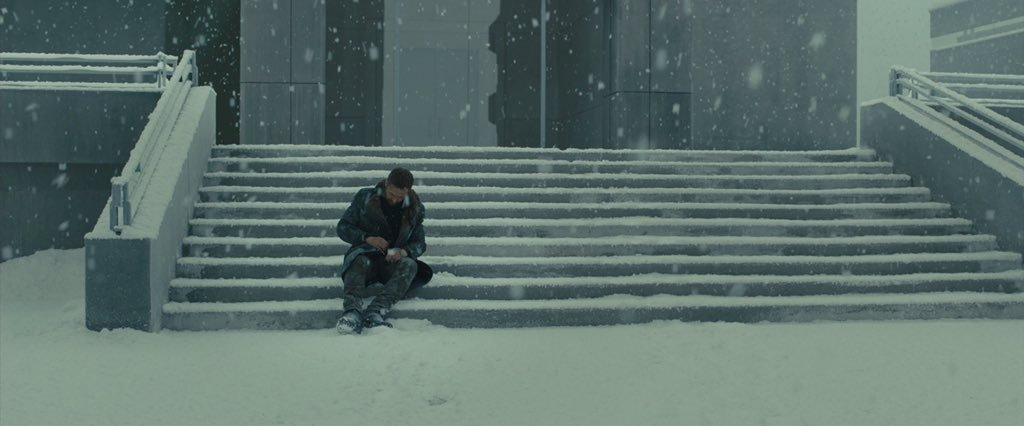
Blade Runner 2049, Denis Villeneuve, 2017.
2. An Anthropology of a World Without Agōn
2.1. Anagony: Definition and Stakes
If technology ceases to make the human, the anthropological question shifts. Until now, it concerned what human beings become through their technology; from now on, it concerns what remains human when technology ceases to produce them. The concept of anagony belongs at precisely this point.
We propose this neologism—from Greek an-, a privative prefix, and agōn, “struggle,” “contest,” or “ordeal”—to name the condition of a world in which ordeal, as an anthropological structure, has disappeared. Anagony is neither apathy nor numbness. Anagonic subjects are not insensible: they still experience affects, pleasures, irritations, and sorrows. What has dissolved is not affectivity itself, but the relation through which affectivity was inscribed in a process of individuation. Agōn is not suffering; it is the demand that, by asking something of the subject, constitutes them in turn. Anagony is the paradoxical condition of a subject who is still moved, but has lost what once tested them.
Tradition has treated agōn within restricted fields. Arendt confined it to the political sphere—the “agonal spirit” as the desire to distinguish oneself within the plurality of the polis[20]. Mouffe brought it into contemporary democratic debate as a form of conflictual pluralism irreducible to consensual deliberation. These uses retain their value, but do not exhaust what the term can express. We extend it to its full anthropological scope: agōn names the general structure through which a resistant world calls on a subject to form themselves against it, within it, and through it. It is the individuating tension described by Simondon (2005), but named in its specifically human register.
The preceding section showed that generative AI breaks anthropotechnical co-constitution by tending toward production without gesture. This section asks what happens to human beings in the wake of that rupture. Anagony is the answer: not the disappearance of the human, but the abolition of the conditions through which a person constituted themselves as a subject.
This abolition calls for two connected anthropological gestures. The first is to describe the human form that is actually emerging under the anagonic condition—a new human type, with its own consistency, affectivity, and relation to the world. The second is to recognize that the collapse of the modern anthropotechnical model makes another possible human type visible again by contrast: the one premodern Europe conceived in terms of contemplation, decreation, and Gelassenheit. These two anthropologies come into view together: one through its disintegration, the other in the space that disintegration opens. An anthropology of a world without agōn cannot be merely an elegy for the first; it must also sketch the second. That is the double task we must now undertake.
2.2. The Phenomenology of the Anagonic World
To describe anagony from the outside would be to make it abstract. We must begin with what the anagonic subject experiences—or, rather, no longer experiences—with what they are deprived of without being able to name that deprivation.
The first phenomenological feature of anagony is the disappearance of what we call, adapting a concept from biology, individuating stimulation: the dose of ordeal required to form a subject. Contemporary biology has developed a rigorous body of knowledge on this question, one that philosophers have unfortunately ignored. Hormesis describes a J-shaped or inverted-U dose-response law: a low to moderate dose of a stressor produces a beneficial effect, while a zero dose produces atrophy and an excessive dose causes destruction (Calabrese and Baldwin, 2003)[21]. The Yerkes-Dodson law, formulated as early as 1908, had already established this for cognitive performance: moderate stress maximizes learning, while no stress diminishes it just as excessive stress does (Yerkes and Dodson, 1908)[22]. This law is not locally valid; in Calabrese’s words, it is “broadly generalizable as being independent of chemical/physical agent, biological model, and endpoint measured” (Calabrese and Baldwin, 2003, p. 175). Anagony names precisely the condition in which the dose of ordeal falls below the hormetic threshold: the subject is not destroyed by excessive stress, but atrophies through deprivation.
Bostrom anticipated this atrophy without grasping its anthropological significance. He calls deep redundancy the condition in which “we have no instrumental reasons for doing anything”—where AI and full automation make not only paid work redundant, but also the effort of raising a child, learning, maintaining oneself, or cooking (Bostrom, 2024)[23]. We translate the term as deep redundancy and take it as an exact phenomenological description of the ground on which anagony unfolds. Bostrom even intuitively grasps the structural nature of the loss: he speaks of an “exoskeleton of enforced toil” that gave shape to the softer parts of the soul[24]. Where we part ways with him is in our assessment of the remedy. He proposes a “five-ringed defense”—hedonic valence, experience texture, autotelic activity, artificial purpose, and sociocultural entanglement—which he presents as sufficient to “absorb” the problem of meaning (Bostrom, 2024, pp. 163–64)[25]. These five rings are actually five prostheses. They substitute a simulacrum of meaning for the vanished structure of ordeal. Rather than resolving it, they confirm the thesis of anagony: when ordeal can no longer occur, only its imitation remains.
Some embrace this diagnosis and see it as the very horizon to aim for. Land explicitly identifies capitalism and artificial intelligence as “a single thing”—the same dynamic of intelligence optimization turned into an end in itself, a declared reversal of means and ends (Land, 2025, p. 105)[26]. On the left, Srnicek and Williams reverse the valence but not the structure, calling for “a fully automated economy” that frees humanity from work through a universal basic income and a reduction in working hours (Srnicek and Williams, 2015)[27]. Our disagreement with Land, Srnicek, and Williams is not about their economic diagnosis or the technological dynamic they describe. The full automation of production, the tendency of AI toward a post-work regime supported by robots, the convergence of capitalism and artificial intelligence: these are already unfolding facts, and contesting their trajectory would be futile. Our disagreement concerns the anthropology they assume. Both take it for granted that removing effort will produce a desirable life. Yet it was precisely this effort that produced the desiring subject. Without realizing it, they show that anagony can be willed as liberation—and it is this desire that reveals how profoundly the contemporary world misunderstands what made us human.
Huxley anticipated this configuration. In the World State of Brave New World, the motto consists of three words: “Community, Identity, Stability” (Huxley, 1932)[28]. And when, by accident, “a similar chasm in time yawned open in the solid substance of their distractions,” soma fills the gap[29]. Bostrom presents as remedy what Huxley had already described as dystopia. Soma is nothing more than hedonic valence made political; stability is deep redundancy made into an order. Economics and utilitarianism run up against the only truth that matters here: we can build a world in which everyone is doing well and no one becomes themselves.

2.3. Post-Logism: The Matrix
What we have just described is not one problem among others. It is not a passing crisis of meaning, a civilizational fatigue, or an episode in the melancholy of late modernity. It is the symptom of a deeper anthropological fact, which we propose to call post-logism.
Post-logism names the condition in which the logos, after being progressively externalized into tertiary retentions, crosses a qualitative threshold and becomes executable without a subject. In Stiegler’s analysis, proletarianization passed through three stages: the proletarianization of gesture, denounced by Marx; of know-how, completed by the machine tool described by Simondon; and of ways of life, through the programming industries (Stiegler, 2001)[30]. Generative AI radicalizes this third stage to the point of changing its nature. We call this threshold noetic proletarianization. Post-logism and noetic proletarianization thus describe the same thing at two scales: the first names it as the anthropological condition of humanity as a whole; the second names it as a specific technical operation applied to the individual logos.
At the turn of the century, Stiegler wrote that “the confusion of logistics and symbol, that is, their uncritical integration, leads to the simple proletarianization of the mind and the impoverishment of culture” (Stiegler, 2001)[31]. He died before the advent of large language models. Had he lived to see them, he would have recognized that his sentence still understated what was coming. What is being industrialized now is no longer just memory or attention: it is the production of meaning itself, right down to its symbolic form.
This shift produces a specific affect that we call noetic shame, adapting to the nous the Promethean shame Anders diagnosed in the face of technological artifacts. It is the shame of thought before a cognitive operation better performed by a machine that does not think. Noetic shame is the moment when a subject who believed their dignity rested on their logos discovers that their logos is technically redundant. This shame is not depression; it is the moment when the anagonic condition makes itself felt.
These concepts outline a distinct human form whose features are beginning to be documented. The anagonic human shares a kinship with the contemporary depressed person, but differs in one decisive respect. In 1998, Ehrenberg described as a “tragedy of inadequacy” what had replaced the “neurosis of guilt”: a subject who is less culpable than incapacitated, “tired of undertaking to become only himself” (Ehrenberg, 1998, p. 15)[32]. The anagonic human is this subject at a later stage. In Ehrenberg’s account, the depressed person still suffers from the demand to become; they exhaust themselves trying to achieve what they can no longer bring about. The anagonic human is the one in whom the demand itself has dissolved. They are no longer tired of having to become; they no longer have to become. The inhibition, slowing, and asthenia Ehrenberg calls a “breakdown of action” become, under the fully anagonic condition, a stable state: no longer a form of suffering, but a prevailing mood. The relation to time changes accordingly. The present stretches into a flat presence without a future that makes demands. Desire, deprived of the fertile lack that gave it tension, shrinks into chronic satiety punctuated by small renewals of stimulation. This person is not unhappy. They inhabit an affective register in which sadness has lost its edge and joy its tension, where emotions remain but lack the spur that once directed them toward something.
Post-logism, noetic proletarianization, and noetic shame form a system. They name, respectively, the anthropological condition, its technical operation, and its subjective affect. Together they recast what sections 2.1 and 2.2 described phenomenologically: anagony is the anthropological effect of an externalization of the logos that has become constitutive. We still need to understand what happens to collective life under this condition.
2.4. Collective Anagony
Can a society hold together when the ordeal that formed its subjects has disappeared? Deprived of what bound its members together by requiring them to measure themselves against the world[33], society seeks to artificially reconstruct the structure it has lost. This reconstruction follows two slopes, which coexist and call forth one another.
The first is the path of convulsion. It consists in forcing agōn to return by surrendering to formations that offer, in the moment, the intensity denied by a smoothed-over world. In 1941, Fromm described the mechanism: when “primary bonds” break apart and the subject is left exposed, “two paths open up”—one toward positive freedom, the other toward escape into “secondary bonds” through submission, destruction, or fusion with an authority (Fromm, 1963)[34]. Within this framework, fascism becomes a possibility that reopens whenever ordeal is absent and the fear of emptiness becomes unbearable. Anagony does not mechanically generate fascism, but it provides its anthropological soil. Bostrom himself, unintentionally, names this possibility when he writes that “our psyches […] have formed in ways that assume [the] presence” of instrumental constraints—and that removing them without providing a substitute creates pathological dependence[35]. What he presents as an individual risk, we present as a political one.
The second path is torpor. Instead of forcing agōn to return, it organizes its peaceful disappearance through a hedonistic form of governmentality. Its model is Huxley, not Orwell. The anagonic human is kept in a stable state of contentment through the combined mechanisms of consumption, distraction, and now cognitive assistance. Bostrom, without admitting it, describes the program himself when he lists his five rings of defense: hedonic induction, experiential textures, autotelic activities, manufactured meaning, and sociocultural entanglements (Bostrom, 2024, p. 163). It is a maintenance plan for subjects who have become unable to individuate themselves through the world, presented in the trappings of philosophy. Huxley saw the matter more clearly than Bostrom is willing to see it: stability requires neither violence nor repression; it requires only that thought never have the leisure to open into a chasm in time.
Convulsion and torpor work together. An anagonic society may oscillate between phases of stabilized torpor and phases of agonic convulsion. The first produces the second through an excess of emptiness; the second, by exhausting excitement, calls the first back in turn. Yet neither restores ordeal as an individuating structure. They simulate it, intensify it, saturate it. They do not return to it.
2.5. Resources: Another Anthropology
The question remains. If ordeal has given way as an anthropotechnical structure, can it be restored at all? And if so, where should we begin?
We must first set aside a false solution, tempting because it appears to come from the left. Productivist collectivisms—whether socialist, Keynesian, syndicalist, or expressed today as a universal basic income supported by full automation—cannot answer anagony because they share one of its assumptions: that freedom from effort is a good in itself. As early as 1932, Russell argued for a four-hour workday on the grounds that “the morality of work is the morality of slaves” (Russell, 2002 [1932])[36]. Srnicek and Williams renew this confidence in a humanity that will spontaneously produce culture once freed from toil (Srnicek and Williams, 2015). Their economic diagnosis may be correct. Their anthropological diagnosis is not. It assumes the Cartesian-Promethean subject that anagony is precisely dissolving. An anagonic human returned to leisure does not become Goethe; they enter one of the two paths described in section 2.4[37].
The real resource lies elsewhere. It has existed for a long time in Europe itself, before productivist modernity covered it over. The European contemplative tradition—Eckhart and Gelassenheit, the Benedictine rule of ora et labora, Simone Weil and decreation—does not think of the human as producer, but as one who waits. What it offers is not a private spirituality, but an anthropology: another anthropology, grounded in another mode of ordeal.
We need to understand what this means. The modern subject individuated itself through resistance to the world: it constituted itself against what resisted it by producing, building, and transforming. This is the mode of ordeal that anagony abolishes. But another mode of ordeal has existed, and may still exist: individuation through sustained attention rather than resistance. In this mode, ordeal is no longer the effort of a gesture that would conquer the world; it is a sustained presence to what is given. It is an active fidelity to what is, against dispersion, distraction, and forgetting. This mode demands as much as the first—perhaps more. What it does not demand is production.
Weil gave the most concise formulation: “Perfect joy excludes even the feeling of joy, for in the soul filled by the object, no corner remains from which to say ‘I’” (Weil, 1947)[38]. This is not a mystical sentence; it is an anthropological one. It describes a mode of experience in which the subject is formed by allowing the world to inhabit them, rather than by opposing it. Weil’s decreation is an active consent, which requires an “I” to consent. This is where the most delicate distinction in this section lies. Weil saw it: “Decreation: passing from the created into the uncreated. Destruction: passing from the created into nothingness. Guilty ersatz of decreation.”[39] Left to itself, anagony is not decreation; it is its guilty ersatz, the dissolution of the “I” without an “I” that consents. Contemplative traditions are therefore not a remedy for anagony. They point to another possible mode: one in which what anagony brings about by default can be achieved through disposition—where the loss of the sovereign subject opens onto another way of being a subject, rather than leaving behind only a residue.
Contemporary contemplative neuroscience, following in the wake of Wallace (2007) and Thompson (2015), is beginning to document this other mode empirically. Sustained attention is a capacity that can be cultivated; its atrophy—which Wallace calls attentional imbalance, ranging between deficit and hyperactivity—is a civilizational pathology as real as the pathologies of the organs[40]. What European monastic traditions had recognized and practiced, neuroscience is now rediscovering by other paths, identifying an anthropological fact obscured by productivist modernity.
One clarification is needed here. Individuation through sustained attention is by no means specifically European. All great civilizations have developed their own cultural technologies of ordeal through presence: Buddhist samatha meditation and zazen, Stoic spiritual exercises, Sufi asceticism, the Japanese mono no aware, and the hesychast practices of Eastern Christianity. Across its major traditions, humanity has recognized that a mode of individuation can be grounded in sustained presence rather than production. We emphasize European resources here for a specific reason: productivist modernity covered them over, and its collapse makes them accessible again to its heirs without requiring them to leave their own cultural ground. The point is not to replace one civilization with another, but to rediscover, in one’s own soil, the resources that had been buried there.
We do not conclude this section with a program. We conclude by sketching the space it leaves open. On one side, the Cartesian-Promethean subject, constituted by productive ordeal, disintegrates into anagony because the anthropotechnical condition that sustained it has given way. On the other, a subject whose individuation proceeds through sustained attention and consent to what is given—a subject Europe knew before Cartesianism, marginalized but never destroyed, and made visible again by the collapse of the first. Between these two anthropologies, technological progress will not decide the outcome. What will matter is whether our societies can recognize, in the resources they carry without cultivating them, the basis for a human form no longer dependent on an ordeal that technology has now withdrawn.
Notes
[1] “Enframing” translates Heidegger’s term Gestell, central to “The Question Concerning Technology” (a 1953 lecture, published in Essays and Lectures, trans. A. Préau, Gallimard, 1958). Gestell names the mode of revealing specific to modern technology, which challenges the real to disclose itself as standing-reserve (Bestand), available for exploitation. Human beings are then not only the ones who issue the challenge; they are challenged in turn. In the very act by which they enframе nature, they are themselves reduced to one resource among others.
[2] The Promethean gap (prometheisches Gefälle) is the guiding concept of The Obsolescence of the Human Being (Anders, 2002 [1956]). It names the growing gap between our capacity to manufacture things technologically and our capacity to imagine the consequences of what we produce. Promethean shame arises from this gap: a sense of human inadequacy before the supposed perfection of our machines. It is a distinct but related concept that we will use in the next section.
[3] OpenAI, “Introducing ChatGPT,” November 30, 2022, openai.com/blog/chatgpt. By January 2023, the model had reached 100 million monthly active users, making it the fastest-adopted consumer application ever measured.
[4] The industrial deployments cited are documented by the manufacturers and their partners: an eleven-month pilot between Figure AI and BMW Group in Spartanburg (announced by Figure AI in August 2024); the integration of Digit into Amazon warehouses (announced by Agility Robotics in 2023, then expanded commercially in 2025); and the deployment of Apollo at Mercedes-Benz (announced by Mercedes-Benz and Apptronik in March 2024). For mass production projected to begin in 2026, see Goldman Sachs, The Humanoid Robot Market Opportunity, January 2024.
[5] Anthropic, Economic Index, a series of reports published since February 2025, anthropic.com/economic-index. The fifth report, Massenkoff and McCrory, “Labor market impacts of AI: A new measure and early evidence” (March 2026), measures the gap between current AI adoption and its theoretical coverage of tasks across the more than 800 occupations listed in the U.S. Department of Labor’s O*NET database.
[6] The thesis of anthropotechnical co-constitution is developed by Leroi-Gourhan in Gesture and Speech (Leroi-Gourhan, 1964, 1965), systematized philosophically by Stiegler in Technics and Time (Stiegler, 1994, 1996, 2001), and taken up under the acronym TAC (Technique Anthropologiquement Constitutive, or “Technics as Anthropologically Constitutive”) at the COSTECH laboratory (Connaissance, Organisation et Systèmes Techniques) of the University of Technology of Compiègne, founded in 1993. See Steiner, “Philosophie, technologie et cognition : état des lieux et perspectives,” Intellectica, nos. 53–54, 2010.
[7] The concept of neoteny, which refers to the persistence of juvenile or fetal characteristics into adulthood, was applied to human beings by Louis Bolk in The Genesis of the Human Being through Neoteny (1926), and later taken up by Stephen Jay Gould in Ontogeny and Phylogeny (Harvard University Press, 1977). Sloterdijk uses it in You Must Change Your Life (Sloterdijk, 2011), where he characterizes Homo sapiens as “constitutionally an invalid of prematurity, a creature destined for eternal immaturity that, given this characteristic biologists call neoteny […], can survive only in the incubators of culture.”
[8] The sentence concludes the presentation of the three types of memory—genetic, epigenetic, and epiphylogenetic—in Part One, Chapter 3 of The Fault of Epimetheus, just before §13, entitled “The Who and the What” (Stiegler, 1994, §12).
[9] “Not knowing how to do anything with one’s ten fingers is not very worrying at the level of the species, since many millennia will pass before such an old neuromotor apparatus regresses. At the individual level, however, things are quite different: not having to think with one’s ten fingers is to lack a part of one’s normally, phylogenetically human thought” (Leroi-Gourhan, 1965).
[10] Jacques Derrida, “Plato’s Pharmacy,” first published in Tel Quel, nos. 32 and 33 (1968), then republished in Dissemination (Derrida, 1972). The Greek word pharmakon means remedy, poison, and charm; Derrida sees in it the constitutive undecidability of writing.
[11] The analysis already appears in Plato’s Phaedrus, 274c–275b. There, Theuth presents writing to Thamus as a remedy (pharmakon) for memory, only to be told that it will instead be its poison. Stiegler takes up and transforms this analysis beginning in Volume III of Technics and Time (Stiegler, 2001), then develops it systematically in later works, notably For a New Critique of Political Economy (Stiegler, 2009) and What Makes Life Worth Living: On Pharmacology (Stiegler, 2010).
[12] The concept of the exosomatic organ derives from a distinction proposed by the biologist and mathematician Alfred Lotka in 1945 between endosomatic instruments, which belong to the individual organism from birth (wings, claws, feet), and exosomatic instruments, which are not part of the body but extend it (tools, machines). In The Entropy Law and the Economic Process (Harvard University Press, 1971), Nicholas Georgescu-Roegen developed a bioeconomics according to which human beings are characterized by the continuation of biological evolution through exosomatic means. Stiegler incorporated the concept into his general organology.
[13] Stiegler, afterword to the 2018 Fayard edition of Technics and Time, “The New Conflict of Faculties and Functions in the Anthropocene,” §2, “Economy, Exosomatization, and Entropy.”
[14] Stiegler borrows the concept of individuation from Gilbert Simondon, who developed it in his doctoral thesis, defended in 1958 and published in two separate parts: Individuation in Light of Notions of Form and Information (PUF, 1964) and Psychic and Collective Individuation (Aubier, 1989). The complete edition was published in 2005 by Jérôme Millon under the original title L’Individuation à la lumière des notions de forme et d’information. Individuation names the process by which a being constitutes itself as an individual by actualizing a preindividual charge, rather than being treated as if its individuality were already complete and given.
[15] Chatonsky, “Les deux pharmakon,” chatonsky.net/pharmakons. The author argues that, against Derrida’s lesson of undecidability, Stiegler tried to separate the good and bad uses of the pharmakon, thereby restoring the figure of the masterful subject.
[16] Kant, Critique of Pure Reason, “On the Schematism of the Pure Concepts of the Understanding,” A 141 / B 180 (Kant, 1944).
[17] Stiegler, Technics and Time, vol. III, Cinematic Time and the Question of Malaise, Chapter 2, “The Cinema of Consciousness,” §3, “Hollywood, Capital of Industrial Schematism” (Stiegler, 2001). Stiegler draws here on Horkheimer and Adorno, Dialectic of Enlightenment (1944; Horkheimer and Adorno, 1974).
[18] The phrase appears in Volume II of Gesture and Speech (Leroi-Gourhan, 1965), where Leroi-Gourhan distinguishes three moments in the history of externalization: the tool; the motorized machine; and information automations that extend the relational nervous system—that is, the functions of processing and transmitting information.
[19] On the three stages of grammatization—alphabetic, analogical, and digital—see Stiegler, For a New Critique of Political Economy (Stiegler, 2009), as well as States of Shock: Stupidity and Knowledge in the Twenty-First Century (Mille et une nuits, 2012).
[20] Arendt, The Human Condition (Arendt, 1961), Chapter V, on the Greek agōn as a principle of distinction in the polis. The idea of the “agonal spirit” is developed in particular in §25 (“Power and the Space of Appearance”).
[21] Calabrese and Baldwin, “Hormesis: The Dose-Response Revolution” (Calabrese and Baldwin, 2003, p. 175). The “broad generalizability” of hormesis—its independence from the agent, biological model, and endpoint—is the article’s central thesis. The hormetic curve is illustrated on p. 178 (Fig. 1): a low dose stimulates, a high dose inhibits, and the stimulatory maximum typically lies between 130% and 160% of the control.
[22] Yerkes and Dodson, “The Relation of Strength of Stimulus to Rapidity of Habit-Formation” (Yerkes and Dodson, 1908); revisited in Calabrese and Baldwin (2003, p. 185).
[23] Bostrom, Deep Utopia (Bostrom, 2024, chapter “Wednesday,” section “From Shallow to Deep Redundancy”): “the deep redundancy [is the condition] in which we have no instrumental reasons for doing anything.”
[24] Bostrom (2024, p. 163), section “Paradox of Progress”: “we may have become dependent on encountering demands for mental and physical exertion and goal-directed striving. Such externally imposed pressures to exert effort in order to satisfy instrumental needs not only keep our bodies in shape but they also help give shape to the softer parts of our souls, rather like a spiritual version of the exoskeleton that structures and contains the innards of a beetle.”
[25] Bostrom (2024, pp. 163–64), section “A Five-Ringed Defense.” The five rings are: Hedonic Valence, Experience Texture, Autotelic Activity, Artificial Purpose, and Sociocultural Entanglement.
[26] Land, Xenosystems (Land, 2025, p. 105), chapter “Monkey Business” (dated November 24, 2013): “intelligence optimization and means-end reversal are the same thing […] the telic innovation common to capitalism and actual artificial intelligence—which are a single thing.”
[27] Srnicek and Williams, Inventing the Future (Srnicek and Williams, 2015, Chapter 6, section “Full Automation”): “we argue that the tendencies towards automation and the replacement of human labour should be enthusiastically accelerated and targeted as a political project of the left.”
[28] Huxley, Brave New World (Huxley, 1932, p. 33 of the Pocket edition): “the World State’s motto: Community, Identity, Stability.”
[29] Ibid., p. 76: “there is always soma, delicious soma, half a gram for a half-holiday, a gramme for a week-end, two grammes for a trip to the gorgeous East, three for a dark eternity on the moon.”
[30] Stiegler reconstructs the genealogy of proletarianization (gesture → know-how → savoir-vivre) in relation to Simondon’s On the Mode of Existence of Technical Objects (PUF, 1958). See especially Stiegler (2001), Volume III, on the loss of individuation in Simondon.
[31] Stiegler, Technics and Time, vol. III, Chapter 1 (Stiegler, 2001): “The confusion of logistics and symbol, that is, their uncritical integration, leads to the simple proletarianization of the mind and the impoverishment of culture.”
[32] Ehrenberg, The Weariness of the Self: Diagnosing the History of Depression in the Contemporary Age (Ehrenberg, 1998, p. 15 of the 2000 edition): “If neurosis is a drama of guilt, depression is a tragedy of inadequacy. It is the familiar shadow of the unguided person, tired of undertaking to become only himself.” On depression as a “breakdown of action” rather than a sorrowful passion, see pp. 13–15. We take up this diagnosis while radicalizing it: what Ehrenberg describes as the contemporary tragedy of inadequacy is an intermediate stage between the modern subject, compelled to become, and the properly anagonic subject, in whom the compulsion itself has dissolved.
[33] Arendt (1961), §7, “The Public Realm: The Common”: “The public realm, the common world, gathers us together and yet prevents our falling over each other, so to speak. What makes mass society so difficult to bear is not, primarily at least, the number of people involved, but the fact that the world between them has lost its power to gather them together, to relate and to separate them.”
[34] Fromm, Escape from Freedom (Fromm, 1963, Chapter V, “Mechanisms of Escape,” section “Authoritarianism”): “Once the primary bonds which gave security to the individual are cut, once the individual faces the outside world as a completely separate entity, two paths are open to him to overcome the unbearable state of powerlessness and aloneness.”
[35] Bostrom (2024, p. 163), section “Paradox of Progress.”
[36] Russell (2002 [1932]): “The morality of work is the morality of slaves, and the modern world has no need of slavery.”
[37] Han, The Burnout Society (Han, 2024), chapter “Beyond the Disciplinary Society”: the achievement-subject as one who exploits himself. We take up Han’s phenomenological diagnosis while moving beyond it: what he describes as a feature of a post-disciplinary society, we read as the first visible manifestation of the anagonic condition, whose anthropotechnical genealogy he does not address.
[38] Weil, Gravity and Grace (Weil, 1947), section “Decreation”: “Perfect joy excludes even the feeling of joy, for in the soul filled by the object, no corner remains from which to say ‘I’.”
[39] Ibid.: “Decreation: passing from the created into the uncreated. Destruction: passing from the created into nothingness. Guilty ersatz of decreation.”
[40] Wallace, Contemplative Science (Wallace, 2007, Chapter 2, section “Attentional Imbalances”), on attentional deficit and attentional hyperactivity as opposing pathologies, and on cultivating mindfulness as a remedy. See also Thompson, Waking, Dreaming, Being (Thompson, 2015), for a systematic integration of the dialogue between phenomenology, cognitive neuroscience, and contemplative traditions.
Bibliography
Anders, Günther. 2002. The Obsolescence of the Human Being: On the Soul in the Age of the Second Industrial Revolution (1956). Translated by C. David. Paris: L’Encyclopédie des nuisances / Ivréa.
Arendt, Hannah. 1961. The Human Condition. Translated by G. Fradier. Paris: Calmann-Lévy.
Bostrom, Nick. 2024. Deep Utopia: Life and Meaning in a Solved World. Washington: Ideapress.
Calabrese, Edward J., and Linda A. Baldwin. 2003. “Hormesis: The Dose-Response Revolution.” Annual Review of Pharmacology and Toxicology 43: 175–197.
Derrida, Jacques. 1972. Dissemination. Paris: Seuil.
Ehrenberg, Alain. 1998. The Weariness of the Self: Depression and Society. Paris: Odile Jacob.
Fromm, Erich. 1963. Escape from Freedom (1941). Translated by C. Janssens. Paris: Buchet-Chastel.
Han, Byung-Chul. 2024. The Burnout Society (2010). Translated by O. Mannoni. Paris: Presses universitaires de France.
Heidegger, Martin. 1958. Essays and Lectures. Translated by A. Préau. Paris: Gallimard.
Horkheimer, Max, and Theodor W. Adorno. 1974. Dialectic of Enlightenment (1944). Translated by E. Kaufholz. Paris: Gallimard.
Huxley, Aldous. 1932. Brave New World. Translated by J. Castier. Paris: Plon.
Kant, Immanuel. 1944. Critique of Pure Reason. Translated by A. Tremesaygues and B. Pacaud. Paris: Presses universitaires de France.
Land, Nick. 2025. Xenosystems. New York: Passage Press.
Leroi-Gourhan, André. 1964. Gesture and Speech, vol. I, Technique and Language. Paris: Albin Michel.
Leroi-Gourhan, André. 1965. Gesture and Speech, vol. II, Memory and Rhythms. Paris: Albin Michel.
Russell, Bertrand. 2002. In Praise of Idleness (1932). Translated by M. Parmentier. Paris: Allia.
Simondon, Gilbert. 2005. Individuation in Light of Notions of Form and Information. Grenoble: Jérôme Millon.
Sloterdijk, Peter. 2011. You Must Change Your Life (2009). Translated by O. Mannoni. Paris: Libella Maren Sell.
Srnicek, Nick, and Alex Williams. 2015. Inventing the Future: Postcapitalism and a World Without Work. London: Verso.
Stiegler, Bernard. 1994. Technics and Time, vol. I, The Fault of Epimetheus. Paris: Galilée.
Stiegler, Bernard. 1996. Technics and Time, vol. II, Disorientation. Paris: Galilée.
Stiegler, Bernard. 2001. Technics and Time, vol. III, Cinematic Time and the Question of Malaise. Paris: Galilée.
Stiegler, Bernard. 2009. For a New Critique of Political Economy. Paris: Galilée.
Stiegler, Bernard. 2010. What Makes Life Worth Living: On Pharmacology. Paris: Flammarion.
Thompson, Evan. 2015. Waking, Dreaming, Being: Self and Consciousness in Neuroscience, Meditation, and Philosophy. New York: Columbia University Press.
Wallace, B. Alan. 2007. Contemplative Science: Where Buddhism and Neuroscience Converge. New York: Columbia University Press.
Weil, Simone. 1947. Gravity and Grace. Paris: Plon.
Yerkes, Robert M., and John D. Dodson. 1908. “The Relation of Strength of Stimulus to Rapidity of Habit-Formation.” Journal of Comparative Neurology and Psychology 18: 459–482.
Zuboff, Shoshana. 2020. The Age of Surveillance Capitalism (2019). Translated by B. Formentelli and A.-S. Homassel. Paris: Zulma.
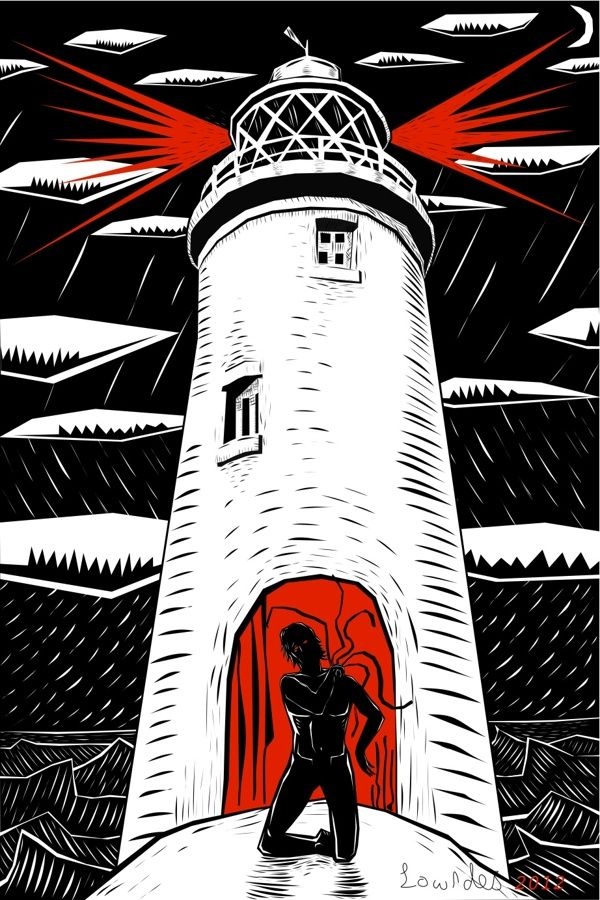
Image credits — Featured image: 2001: A Space Odyssey, Stanley Kubrick, 1968. Interior images: Blade Runner, Ridley Scott, 1982; Blade Runner 2049, Denis Villeneuve, 2017; Finn Dean, illustration for Aldous Huxley’s Brave New World, Folio Society, 2013; Shaun Lowndes, fan art based on Aldous Huxley’s Brave New World, 2018.