
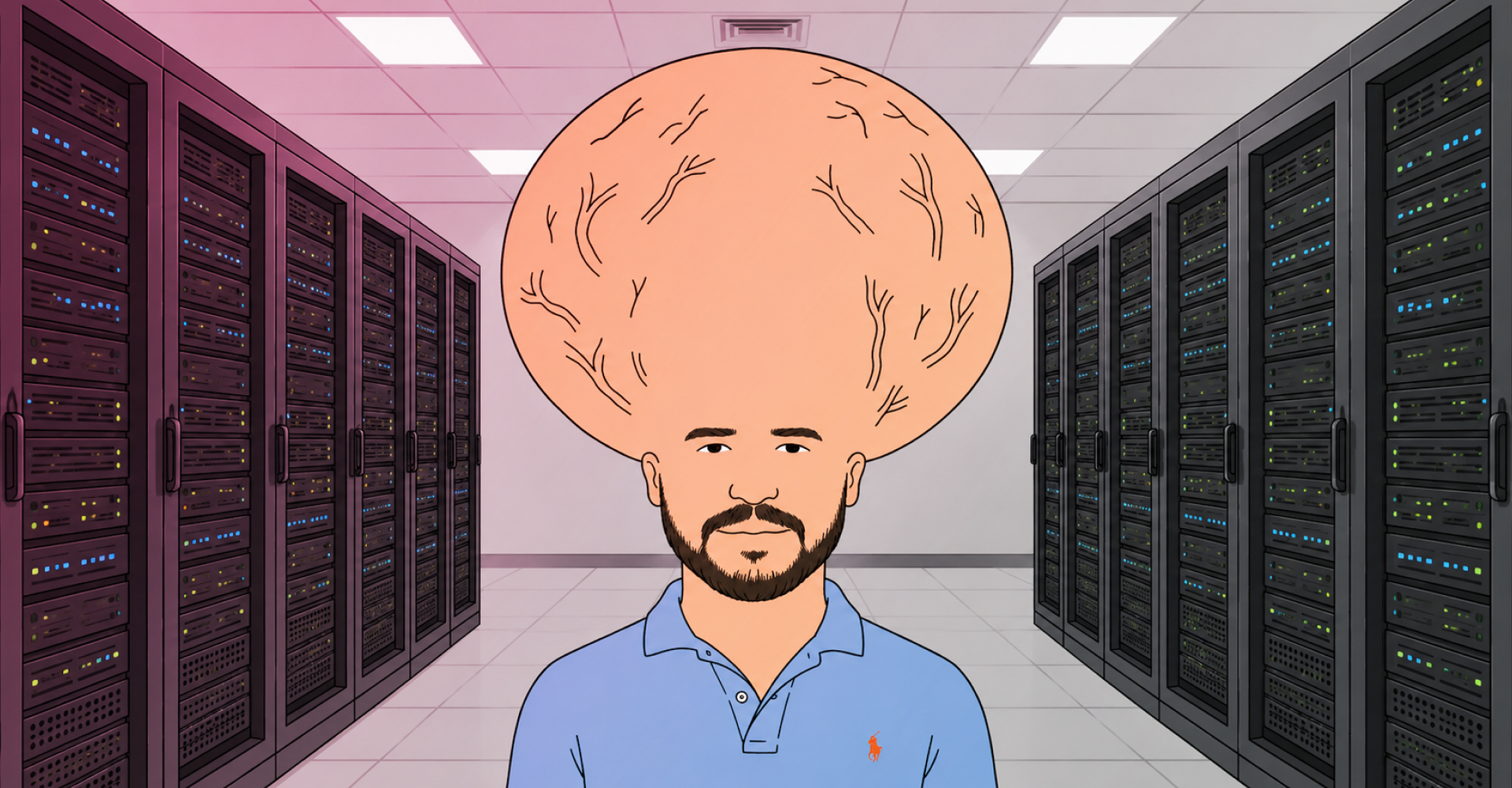

Under the guise of fighting wokeness, and in the very name of Truth, Elon Musk risks unwittingly promoting a more ancient evil: sophistry. By amplifying Brivael’s content, he gives considerable visibility to work that is intellectually weak but perfectly suited to X’s engagement incentives.
If we had to retain two fundamental ideas from Plato, they would be ethics and politics. Ethics is the need to direct the soul toward the Good. This assumes that the soul can suffer from disorders. Politics, then, is the art of ordering the city so as to form, correct, and heal souls. For Plato, Truth is intimately linked to the Good. Unlike Aristotle, for whom truth consists in saying of what is that it is, and of what is not that it is not, Plato sees truth as what reveals the higher order of reality, which we must seek beyond appearances. This conception resonates with some of Musk’s stated ambitions: to make Grok as truth-oriented as possible, to make xAI an instrument for understanding the universe, and to take seriously the possibility that a deeper level of reality lies behind appearances: a simulation from which we might escape. Brivael pretends to adopt this posture when he denounces French Theory in the name of truth, but his actions reveal an attitude much closer to the rhetoric of Gorgias. He claims that the West rests on objective truth accessible to reason and defends the true, the good, and the beautiful, yet three posts later boasts that he deliberately makes spelling mistakes to provoke grammar pedants and boost his posts so he can make more money. He accuses the West of failing to distinguish truth from opinion, but says Rousseau “is shit” and that this is “a fact.” He thus uses words to defend a position that he does not embody in his actions. This Tartuffe’s aim is not the Good, but effectiveness and profitability, like Gorgias. Socrates’ concern in this text is that if such a cast of mind became the norm in politics, that is, among the ruling class, the latter would fail to heal the disorders of individuals’ souls and would fail to promote a healthy order, a cosmos. On X, Musk occupies this distinctive position. His choices about what to amplify, his public statements, and the signals he sends therefore help define what the platform symbolically rewards.
Brivael’s post is not all that bad in itself, and I can broadly agree with the claim that French Theory was one of the ideological sources of wokeness as it developed in the particular sociological context of the United States. This is hardly new. People such as Helen Pluckrose and James Lindsay had already raised the subject in a book they co-authored, accusing French thinkers of having destroyed the West. Quite a claim. Brivael is following in their footsteps ten years late. In other words, it was a moderately interesting thesis, but one that had the courage to be formulated at a time when wokeness was all-powerful. Today, it has become a simple signal of belonging to a new orthodoxy. The book’s authors also had the merit of recognizing French Theory as Nietzsche’s bastard child, whereas Brivael accuses it of being Rousseau’s, imagining that its authors radicalized the same Rousseauian poison using twentieth-century tools. Rousseau’s crime, according to him, was to imagine that man is good in a state of nature prior to society, and that we should strive to return to it. On the one hand, this is a misreading of Rousseau; on the other, it is a complete non sequitur to look for a line of descent from Rousseau to French Theory here.
This betrays a poor understanding of the subject at hand, or at least a certain angle often favored by liberals. Modernity did not have to wait for French Theory to break with this conception of truth. Leo Strauss, it seems to me, offers a useful reading of modern history when he divides it into three waves:
First wave: classical modern liberalism, represented by Hobbes following in Machiavelli’s footsteps.
Second wave: historicism and idealism, represented by Rousseau, Kant, and Hegel.
Third wave: the nihilism of Nietzsche and Heidegger.
On Strauss’s account, the first modern wave is classical liberalism, which begins with Machiavelli and Hobbes before Rousseau comes along and obstructs it. There’s the culprit! The one who destroyed their paradise, their rationalism, their objective truth accessible to reason! On strictly epistemological grounds, however, the decisive break actually predates Rousseau and comes chiefly through Descartes. Brivael praises Descartes while accusing French Theory of exporting suspicion, yet it was Descartes who placed doubt at the foundation of modern philosophical method. We move from an ancient vision, in which truth first presents itself in wonder before the world, to a modern vision in which truth must be reconstructed from the knowing subject. The subject’s only certainty is its own existence. Descartes is obviously no relativist. Hence the famous “I think, therefore I am.” He does doubt, but in order to escape doubt and recover certainty about the external world. He achieves this by reconstructing that world through method, clear and distinct ideas, and divine assurance. Truth is no longer understood as the intellect’s spontaneous correspondence with reality. It must first pass through this subject-centered procedure of certainty before reaching that conclusion.
Do you know who takes the opposite view of truth? Rousseau. Rousseau is deeply influenced by ancient thinkers, while also understanding that it is impossible simply to return to their conception of truth. Truth nevertheless remains central to him: he was prepared to give up material pleasures and social esteem in order to defend it. Rousseau tells us that truth cannot be separated from the moral formation of the human being. Contrary to what Brivael claims, Rousseau does not say that man is born good. Man is better described as pre-moral: he has not yet entered into the social relations that produce comparison, from which amour-propre arises. Rousseau imagines that hypothetical human being in the state of nature as driven by two instincts: amour de soi, which concerns self-preservation or the satisfaction of simple needs, and pity, which gives rise to a spontaneous aversion to seeing another sentient being suffer. He is no saint, but neither is he yet the social man corrupted by the social dynamics inherent in every society. The moral formation of the human being therefore requires recovering within oneself a moral voice that society has buried beneath amour-propre, comparison, prestige, and corruption. According to Leo Strauss, this move is one of the decisive moments of modernity’s second wave: Rousseau criticizes the first modernity, then opens the way to German idealism, beginning with Kant.
Kant departs from Descartes in a substantial way. He no longer seeks to guarantee, from the standpoint of the subject, that our representations correspond to an external world. Instead, he seeks to determine the conditions that make any experience of an object possible for us. The foundation of our knowledge cannot rest on God; it must begin from the subject, of whose existence we alone are certain. This is what we call the Copernican Revolution: Kant reverses our theory of knowledge. It is not our knowledge that must conform to objects; rather, objects as they appear to us conform to the a priori structures of our sensibility and understanding. So it is not so much that our thought enables a correspondence with the world, but that the world we can experience necessarily appears to us according to the forms proper to our way of knowing. Kant preserves the objectivity of truth at the cost of making the human species uniform. Truth depends on the subject, but all rational human beings share the same conditions of experience, and therefore the same way of knowing and, in turn, the same truth.
The third wave of modernity, whose heirs include the thinkers of French Theory, opposes this moral and universal conception of truth. Contrary to what Brivael’s LLM says, French Theory does not take up Rousseau’s poison. Nietzsche is the one who sounds the charge. He does not, however, say that Rousseau is shit. He counts him among the eight thinkers worthy of interest with whom he struggled the most. With Nietzsche, truth becomes a genealogical problem: Who wants the truth? Why do they want it? What form of life does this will to truth serve? Nietzsche no longer asks only whether a proposition is true, but what kind of person needs to believe in that truth. He is the one who breaks the objectivity of truth and makes it perspectival, before Heidegger follows suit and breaks with objecthood. Heidegger seeks a more primordial relation to the world than the simple subject/object opposition, and criticizes the reduction of Being to objecthood. This is probably the hardest part to explain simply, but I think it is an unavoidable detour if we are to understand the ideas inherited by the thinkers under attack. I also think I have found a reasonable way to lay it out.
Heidegger confronts the metaphysical idols of Being by grappling with philosophy’s fundamental question: Why is there something rather than nothing? Science and technology are concerned with understanding how the world is, that is, the “something,” while Nietzsche unsettles metaphysics’ claim to offer an ultimate answer to the “why.” What does it mean to be, this “there is” in the question “Why is there something rather than nothing?” Heidegger observes that we have forgotten Being, the “there is” that must be thought in light of “rather than nothing.” This leads him to distinguish between Being and beings. Beings are “something” and can be objects of scientific study, but Being, the fact that there “is” something, is not an object of knowledge. It is not one being among beings, but the very opening through which something can appear rather than nothing. Science will never be able to answer the mystery that existence presents. That is why Heidegger revises the notion of “truth”: it is no longer understood merely as an epistemological correspondence between a judgment and a being, but as ontological unconcealment, as aletheia. What worries him about technoscience is the possibility that we will lose sight of the importance of the question itself by focusing only on beings. He sees this as a forgetting of the forgetting of Being. This is the distinction he draws between an authentic existence, concerned with Being, and an inauthentic existence carried along by the technological system.
This is the move that Foucault, Derrida, and Deleuze would each take up in their own way. It cannot be dismissed out of hand. Foucault does not say that truth does not exist, as Brivael claims. He argues that a society does not merely possess a body of knowledge that is true or false; it also has to establish procedures that determine which discourses can function as true and which methods will be recognized as legitimate for verifying them. And Deleuze never says that we should give up on all construction. Quite the opposite, my friend. He understands desire as production and the search for assemblages, and therefore as creation. That is why it is laughable to see Brivael’s prompt set Girard, with his mimetic desire, against Deleuze, as though the latter were a thinker of suspicion who makes all construction impossible. Brivael accuses French Theory of thinking only about becoming and not Being, but he does not realize that Being, like truth, is not something we can simply reaffirm without questioning it. What, after all, does Musk mean by “the Truth”? Without clarification, the appeal to Truth risks remaining a powerful intuition, but one that is philosophically inadequate to the questions opened up by Nietzsche and Heidegger.
Still, one could read Musk’s intuition, and to a lesser extent Brivael’s, as a confused but genuine attempt to take up the Straussian project: to escape modern nihilism by reaffirming an orientation toward the true, the good, and the beautiful. Although Leo Strauss was influenced by Nietzsche and Heidegger, he chose to break free of them and thereby chart a path out of this third wave. He chose to return to the Ancients, but this route seems impossible to me for a simple reason Mitchell Heisman brings up in his suicide note. Strauss chooses to escape modern relativism by turning once more toward the ancient absolute of the Good. But the mere fact that this return to the Ancients is a choice seems already to admit that it is only one option among others within the very relativism it claims to overcome. Strauss fails to refute that relativism using premises that his choice must necessarily imply. This is still more coherent than Brivael’s attitude: he blames Deleuze for favoring becoming over Being, yet fails to grasp the force of Heidegger’s argument and himself sinks into the forgetting of the forgetting of Being, with “build” as his only alternative. But build what? To what end? How will that get us out of the impasse he points to without truly understanding its underlying foundations? He does not even see the problem.
For Brivael, the aim is to reach a world of abundance, to produce more “something” that would mark the end of the zero-sum game and usher the world into a positive-sum game. No matter how much “something” is produced, it will always belong to the realm of becoming and can never answer the fundamental question of Being: the wonder that there is something in the first place. Worse still, the quantity of goods produced cannot even bring about the infinite-sum world Brivael imagines. If desire is mimetic, as Girard argues, and we always desire what others desire, then mass-producing the objects of shared desire would seem to be the way to create a conflict-free world. If the cost of production falls to zero, we’ll all have a Ferrari and there will be no reason to fight, right? There is a problem with this line of thought: we will always desire unique things. For instance, we will desire the same woman, and she cannot be mass-produced. Perhaps, then, the builders’ answer is that it is entirely possible to mass-produce her, and that we will have sex with robots, as Laurent Alexandre imagines in his interview for Silicon Carne. Regardless of how well we perform, the robot will tell us, “Oh, you really made me come,” Laurent Alexandre tells us. Isolation would then be the solution to conflict: everyone could be perfectly content in their own bubble. But how, then, do you disagree with Rousseau? He simply argues that society gives rise to dynamics to which the hypothetical human being in the state of nature is not subject. Brivael imagines nothing different, except that Rousseau is wise enough to see that this human being does not exist, while Brivael wants to build the world that would make him possible.
That world will never come, because there is a deeper flaw in the argument, one we reach by applying Girard’s thought consistently. There is one thing that can never be made abundant: status within society. Material abundance can increase the goods available, but it cannot generate more status for everyone, because status is relative by nature. Even if everyone became the master of a village of robots, our mimetic desire would not be satisfied by our superiority over machines; it would turn toward the other humans who were masters of their own robot villages. We are condemned to these dynamics, and the economy, even if it is not a zero-sum game, can never replace politics, which is.
We would therefore need to move beyond modernity’s third, nihilistic wave and reaffirm the idea of the Good as a political end, as Leo Strauss wishes, while finding a different path. That is the aim of my book Traité Néoréactionnaire, and it is an ambition that probably exceeds my abilities. I may be doing it clumsily, but my proposal has the merit of being sincere and different. I start from the same observation as Leo Strauss (and Brivael, for what that is worth): modern Western man no longer knows what he wants and no longer believes that it is possible to know good from evil, or right from wrong. But we cannot simply choose to return to the Ancients. I am trying to establish a realist axiology that reaffirms the possibility of the Good by starting from a modern conception of what exists: entropy. If what exists owes its existence, as a being in space, to its capacity to maintain its structure over time, then we can think about beings in terms of entropy reduction. Ultimately, entropy reduction is statistical: maximum entropy is the most probable, the most chaotic, and the most widespread state. By contrast, every system should theoretically admit a hypothetical, singular state in which it is maximally extropic, ordered, and unique. That singular state should be the goal of politics. It cannot be known a priori, but it can readily be recognized a posteriori and then easily shown. We find it, then, in what we build, but someone guided only by the pursuit of effectiveness and profitability will struggle to produce it.
This connects in some way to the little-discussed conclusion reached by Costin Alamariu in Selective Breeding and the Birth of Philosophy. He rereads the Gorgias to suggest that the position Plato defends is neither the one held by Gorgias nor the one held by Socrates, but the one embodied by Callicles, whom Plato shows us. In other words, contrary to the way Plato is often presented as sharing Socrates’ conception of truth, he may have understood that the true, the good, and the beautiful could not be defended through Socratic logic, but only pointed to in the forms of life that embody them. Gorgias, Socrates, and Callicles thus each illustrate a type of man Plato shows us. Alamariu thinks Plato wants us to see Callicles as the right kind of man, and argues that the Republic itself can then be read as a vast eugenic and pedagogical project: the production of a certain kind of man capable of embodying the political Good. Behind the Platonic Good there may be another intuition: every civilization ultimately rests on an anthropotechnics, that is, on the making of a certain kind of human being. And that is where it gets fascinating, as Brivael would say, because on this reading of the Gorgias, Plato would be much closer to Nietzsche than to Socrates. Alamariu succeeds where Strauss failed. He opens a suitable path for rereading Plato within the continuity of modernity.
The problem, then, is not whether Brivael produced his content with the help of an LLM, or whether the LLM accurately represents the thinkers he discusses. The question is what Brivael’s intentions are, and what they reveal about the kind of man he embodies. He is closer to Gorgias in Socratic clothing than to Callicles. The problem is not that he is subject to financial incentives; we all are. The problem is that he consciously chooses to advertise them and to make his intellectual output an efficient, profitable means of getting views, gaining followers, reaching the powerful, and securing a life of luxury. He will even indulge himself by calling Rousseau shit in the name of truth, even though Rousseau showed it infinitely more respect than Brivael ever will. What we condemn in Brivael is neither his use of an LLM nor the coarseness of his language, but the vulgarity he displays, which seeps from every pore in his masturbatory outbursts.
By amplifying this kind of content, Musk may be sending an unwitting signal about the kind of intellectual output the platform tends to reward and the kind of person who will proliferate there. In effect, he is saying: “I’ll offer you recognition and material pleasures if you, too, churn out astronomical quantities of slop posts.” Brivael is already at 9,000 posts in three months, while I’m at 20,000 in seven years. He is fearsomely efficient. But put his posts (1, 2, 3) into an LLM and ask it to compare them with my critique here. Ask it which is closer to Truth, however one understands that word.
What will happen to X? Brivael will inspire imitators. In trying to fight the woke mind virus, Musk risks letting the wank mind virus emerge. If, as Spandrell notes in his essay on bio-Leninism, the woke mindset led to the rewarding of biological outliers, the wank mind virus promotes mediocre wankers boosted by AI, aping anon themes for a few Elon bucks. Musk will drive away truly brilliant people like Alamariu and the real anons, who watch this circus with all the contempt it deserves.