

I cannot decently present this selection of texts to you without offering at least some explanation. Why did I make this particular selection, and why did I leave out other authors? This introduction gives me a chance both to clarify my intentions and to justify the inclusion of the texts and authors featured in the pages that follow. Through these readings, I want to sketch the contours of technological evolution: to try to understand it for what it is, coolly and realistically. This introduction advances a simple thesis: technology is neither a neutral tool nor a happy destiny. It shapes the kind of person who uses it, and it is this technological anthropology that we must confront. This volume brings together authors who help us understand the path from Greek technē to the Singularity, and locate within it a clear-eyed position: techno-realism.
I. Technology, Commerce, and the Human Type
When we speak of realism, the first name that comes to mind is Machiavelli. Some, better informed, will go back as far as Thucydides. For my part, I think it would not be unreasonable to call Archilochus the first realist. Though a poet, he offered a very different kind of poetry from Homer’s. Homer paints a picture of the warrior ideal; Archilochus sings of the realities of combat and its passions, far removed from any ideals. Archilochus was first and foremost a soldier, so it may seem strange that Adeimantus calls him “very wise” in his discussion with Socrates in Book II of The Republic. Archilochus is rough, vulgar, crude, sarcastic, savage, impulsive, hot-blooded, cynical, and many things besides. But he is not wise, nor was he considered wise by the Greeks.
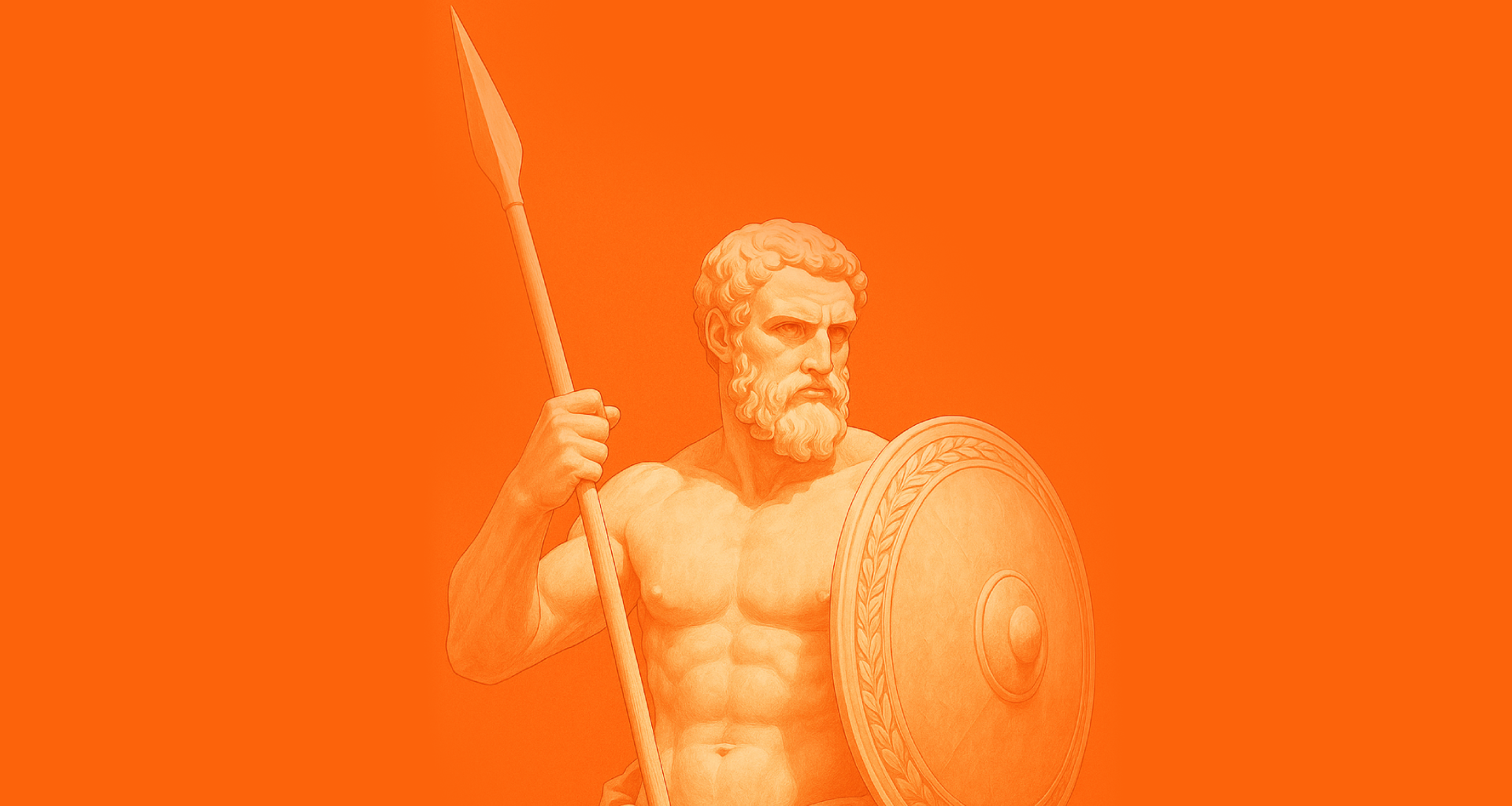
“My spear is my drink, my spear is my harvest,
I feast at the banquet, leaning on my spear.”
—Archilochus, Fragment 2, “The Warrior” (7), The Crown and the Lyre, Marguerite Yourcenar
Archilochus is a warrior-poet. He uses poetry to display his military qualities and, without evasion, explores every vicissitude of the active man’s soul, with little concern for whether any of it is just or good. He highlights how a technical tool such as his spear seems to extend his biological body: it is always with him and becomes a kind of second nature. Yet he also tells how he threw away his shield to escape certain death, an act considered sacrilegious and dishonourable in cities such as Sparta. For him, nature matters more than technique, biology more than ideas. So why does Adeimantus call him wise in the following passage?
—ADEIMANTUS: According to what we are told, if I am just but do not seem to be, I shall gain nothing from it, only trouble and obvious harm; but if I am unjust and have a reputation for justice, I am told I shall lead a life like a god’s. Since, then, appearance, as the wise tell me, does violence to truth and is the master of happiness, I must devote myself entirely to it. I must draw around me an empty image of virtue, as a façade and ornament, and trail behind me the fox of the very wise Archilochus, an animal subtle and rich in cunning.
—Plato, The Republic
Archilochus would, then, be wise to behave in a way no one would call wise. Adeimantus invokes him to argue that it is better to live as though one respected justice, even while using injustice to one’s own advantage. So why does Plato put this character to that use?
In this work, the speakers discuss what the founding of the city rests on. Adeimantus extends Thrasymachus’s idea that injustice is better than justice if one is the person who benefits from injustice, and that might makes right. Socrates, by contrast, argues that the city, born first of need and the division of labour, will eventually be understood as resting on justice alone. Justice is defined as the principle that orders the division of roles and allows individuals to form alliances through balanced exchanges. This is Socrates’ account not only of how a city comes into being, but also of the kind of people who make it up: people unable to provide for themselves and dependent on others for their survival. For Plato, the city arises from need, and therefore indirectly from commerce. Commerce gradually advances through technology; only when the city becomes luxurious does it go to war over resources, making a specialised army necessary for its defence. In the end, that army is used to expand the city.
—SOCRATES: Let us continue, then. What gives rise to a city is each person’s inability to be self-sufficient. Thus exchanges arise, then trades, then the city. […] They will spend their lives together in pleasant company and have as many children as their means allow, for fear of poverty or war.
—Plato, The Republic
By calling Archilochus wise, Adeimantus, playing the devil’s advocate so that Socrates can argue for the benefits of justice, suggests that Archilochus embodies the opposite of what Socrates understands by justice. Archilochus is shocking because he mocks ideals and conventions. He is the anti-Socrates. And yet he helped build cities by taking part in colonising expeditions. Does Archilochus simply embody the military force through which a city expands, or does he reveal that cities are not founded on commerce and law?
Thucydides offers us a different, and perhaps more valuable, account of how a city comes to life. In his work, political order crystallises in a setting of war and raids, then expands through commerce and technical skill, especially naval skill. I encourage you to read The History of the Peloponnesian War in full, but it would obviously be unreasonable to reproduce all eight books, or even all of Book I. So you will find the first twenty-two paragraphs of Book I, which already have much to teach us. Take the time to read them closely, line by line, following Nietzsche’s own advice.
Nothing cures one more radically than Thucydides of the pitiful embellishment, under the guise of an ideal, that a young man with a “classical education” carries into life as a reward for diligence at school. One must follow him line by line and read his hidden thoughts with as much attention as his sentences: few thinkers are so rich in hidden meanings. In him, the culture of the Sophists—I mean the culture of realists—reaches its fullest expression: an invaluable movement amid the moral and idealistic charlatanry of the Socratic school, then raging on every side.
—Nietzsche, Twilight of the Idols
If I had to sum up Thucydides’ argument in a few lines, I would say that he tells us this: he is an Athenian. The city of Athens emerged in a region dominated by nomadic peoples locked in constant warfare. It succeeded through its technical superiority, and technical mastery is precisely what distinguishes an Athenian from a barbarian. Athens’s technological lead meant its citizens were the first who could walk through the city unarmed, something that had once been unthinkable, when danger was everywhere. That danger had prevented commerce from taking root. Once Athens was flourishing, commerce became a driving force for technological development, leading to the rise of a formidable fleet.
Indeed, we can see that what is now Greece was not in ancient times settled in a stable manner. In the earliest days, people migrated, and all readily abandoned their homes whenever they came under pressure from a more numerous force.
There was no commerce, nor any safe communication between peoples by land or sea. Each person drew from his own country just enough to live on: they had no reserves of money and planted no crops, since, with no ramparts to protect them, no one knew when another might come to rob them.
[…]
As Greece grew in power and became more concerned with acquiring wealth, tyrannies arose in most cities, made possible by the increase in monetary revenues. Before that, there had been only hereditary kingships with clearly defined prerogatives.
[…]
If Athens’s name is famous among all men, know that this is because she does not yield to adversity; because she has spent great numbers of men and much labour in war; because to this day she has possessed the most respected power; and because, if one day we should decline, as everything is destined to do, at least an everlasting memory will remain.
—Thucydides, The History of the Peloponnesian War
He describes Athens as a pinnacle of artistic refinement made possible by its technology, and presents the Peloponnesian War as a conflict between a progressive Athens and a traditionalist Sparta. And yet Sparta won. What was Athens missing? Perhaps the answer lies between the lines of Thucydides, in his unspoken thoughts.
It is in your character, handed down to you by your ancestors, to acquire virtue through hardship. Do not change your ways, even though you now enjoy a little more wealth and power. It is not right to lose through wealth what you gained through poverty.
—Thucydides, The History of the Peloponnesian War
Had the Athenians grown soft? Had technology made them soft? We are left with the impression that commerce encouraged the rise of a new kind of person. The soldier Archilochus gave way to the philosopher Socrates. But Socrates was born at the height of Athens’s power. In other words, Athens was built without Socratic teaching; indeed, its decline began just as Socrates could stroll through an unarmed city and discuss ideas. It seems that, while technology is undoubtedly a source of military power, it also promotes comfort and serves as an instrument of control within the city.
From the outset, technology appears to produce a human type. Archilochus’s spear extends the body; Athens’s fleet extends the city. It enables commerce, but may also soften those it protects. The central paradox is already taking shape: technology increases external power while risking the erosion of inner vitality.
II. The Technē of the Logos and Slave Morality
You may now begin to understand why I chose to include Plato in a collection about technology. I did not choose just any dialogue, but one that sets him against the Sophists, whom Nietzsche champions. I encourage you, however, to go beyond simply choosing sides and to read their exchange carefully, since it can tell us something about the Greek conception of technology. The Greeks spoke of technē, meaning craft or technique, and logos, referring to reason or language. They would never have combined these words, except for the Sophists, who spoke of the technē of the logos. For the archaic Greeks, technē was an application of the logos. We moderns understand technology as applied science. But if technē is the application of the mind, then technology would be the application of the mind to the mind. In other words, it is the art of speech—or, more simply, manipulation. For Plato, this does not even deserve to be called an art, because by its nature this activity turns away from the good. It is belief passing itself off as knowledge through flattery; chatter taking on the appearance of truth. Language is a technology, but more broadly, technology is a language. This etymological conception will be key to understanding thinkers such as Heidegger and Ernst Jünger.
Technique, in this sense, is mastery of the language spoken in the realm of work. This language is no less meaningful or profound than any other, for it has not only a grammar but a metaphysics. In this context, the machine plays as secondary a role as the human being: it is merely one of the organs through which this language can be spoken.
—Ernst Jünger, The Worker
It is now easier to see why I thought it appropriate to include Plato’s Gorgias, where he sets out a difference between Socrates and the Sophists over the purpose of discourse. Gorgias claims that his teaching is neutral and can be used for good or evil. For Plato, however, the mere use of manipulative means cannot serve the good. Claiming neutrality is, in Plato’s eyes, a Sophist’s trick. So what does Nietzsche reproach Plato for? Plato reproaches Gorgias for caring nothing about the good, only about effectiveness and the power it brings. Nietzsche, in turn, thinks he sees through Plato’s game. In reality, everyone seeks power, and Plato is merely inventing a moral code that lets him use it as an instrument of control. Plato, too, seeks nothing but power, though he seeks it through morality. More than that, Nietzsche sees this as a mark of the weak. Anyone can use Gorgias’s sophistry, but only the weak use it to manipulate, because the strong have no need of it. Nietzsche sees Socrates as a weak man using language to establish a moral order. He finds Gorgias much more honest: Gorgias openly admits that he teaches the highest good, namely “freedom for oneself and domination over others.” Nietzsche questions the conduct of a man like Socrates, who walks around the city discussing ideas. That is no way for an aristocrat to behave. In fact, Nietzsche identifies much more with Callicles, who points out to Socrates that once you reach a certain age, it is better to stop philosophising.
CALLICLES — For, Socrates, under the pretext of seeking truth, you weary us with rhetorical tricks about what is shameful by nature and what is shameful by law. Nature and law usually contradict each other. So if one is ashamed to say what one thinks, it is impossible to avoid contradiction. You understand this perfectly well, and use it to argue captiously: if someone speaks according to law, you question him according to nature; if someone speaks according to nature, you return to law.
[…]
To suffer injustice is not even a man’s lot: it is fit for slaves, for whom death is better than life, since they are unable to defend themselves or those they love against injustice and abuse. The law, by contrast, is the work of the weak and the many.
—Plato, Gorgias
Nietzsche’s problem with this art of discourse is not that it fails to pursue the good, but that it is a weapon of the weak. It has an equalising power that lets the weak rise to the level of the strong. This is the whole premise of his genealogy of morality: that the Jews, and later the Christians, invented their moral principles as the weak. The Mosaic laws, like all laws, are a technology. Their primary purpose is to control the behaviour of a group’s members, and to be an effective technology they must rest on an absolute. Human beings are subject to optimism bias. Tell people that in 90% of cases, infidelity ends in the destruction of a marriage, and they will naturally imagine that they are among the 10% of exceptions. So it is more effective, and better for organising the group, to proclaim that God has given everyone a law, under threat of divine punishment: “You shall not commit adultery.” Everyone is equal before the law, before God. God is a technology.
It is only in a limited sense that man now wants nothing more than truth: he desires truth’s pleasant, life-preserving consequences. He is indifferent to pure knowledge that has no consequences; he is even hostile towards truths that could be harmful and destructive. And what should we say about these linguistic conventions themselves? Might they be products of knowledge—that is, of a sense of truth? Do names correspond to things? Is language an adequate expression of every reality?
Only through forgetfulness can man come to believe that he possesses a “truth” of such magnitude.
[…]
We still do not know where the desire for truth comes from. Until now, we have heard only of the duty society imposes in order to exist: to be truthful means to use the customary metaphors. To put it morally, it is the duty to lie according to a fixed convention, to lie with the herd, in a way binding on everyone. Of course, man forgets that this is how things are for him. So he lies in the prescribed way, unconsciously, in accordance with habits centuries old.
—Nietzsche, Twilight of the Idols
This is precisely why Nietzsche sees the Good, or God, as a tool the weak use through language to control the strong. Hence his severe criticism of language and the norms it imposes under the pretence of truth. He sees only the lies of the weak, using language as a technology for their own ends. We find a similar idea in the famous line attributed to Samuel Colt, inventor of the revolver that bears his name: “God made men big and small; I made them equal.” Weapons, however, are merely an early stage in a process of equalisation that has long since advanced much further. It will culminate in Andy Warhol’s claim: “What’s great about this country is that America started the tradition where the richest consumers buy essentially the same things as the poorest. You can be watching TV and see Coca-Cola, and you know that the president drinks Coke, Liz Taylor drinks Coke, and you can think that you can drink Coke too.” But is it “great” in itself that everyone drinks Coke? Isn’t that exactly what we would expect if the modern world were tending to produce a single human type: the last man? This is Nietzsche’s concern, and slave morality and technology may go hand in hand in producing the last man. Yet what Nietzsche perhaps fails to see is that Gorgias’s discourse is precisely the discourse of commerce: the detergent that washes whiter than white; flattery and appeals to emotion rather than reason. It accompanies the rise of the new human type Thucydides observed. So it does not seem easy to decide definitively whether Plato or Gorgias is right.
Well, Gorgias, rhetoric seems to me to be a practice that is not a genuine art at all, but one that requires a soul with imagination and boldness, naturally inclined to deal with people.
I give this kind of practice a general name: flattery.
—Plato, Gorgias
With Plato, Gorgias, and Callicles, technology becomes language, and therefore power. For Plato, the technē of the logos is flattery that turns away from the Good; for Callicles, it is a weapon of the weak that equalises the forces at play. Language is a technology that shapes relations of domination. The question becomes: does technology elevate human beings, or does it make them conform?
III. From Unconcealment to Enframing
Technology is not neutral. Heidegger makes precisely this argument, though apparently for reasons quite different a priori from Nietzsche’s. Heidegger is not concerned with power, but with the inauthenticity of modern technology. Still, he reaches a conclusion Nietzsche would recognise: modern technology brings nihilism to its fulfilment and encourages the way of life of the last man. We cannot fully understand Heidegger without returning to the ancients. Copyright restrictions mean that he is the great absentee from this selection, but his work on the question of technology certainly deserved a place here. I can still pay tribute to him with a few quotations.
The essence of technology is by no means anything technological. Thus we shall never experience our relation to the essence of technology so long as we merely conceive and practise technology, put up with it, or evade it. Everywhere we remain unfree and chained to technology, whether we passionately affirm or deny it. But we are delivered over to technology in the worst possible way when we regard it as something neutral; for this conception, which is especially favoured today, makes us utterly blind to the essence of technology.
—Martin Heidegger, “The Question Concerning Technology”
The essence of technology is in no way technological, and technology is not neutral. What, then, is its essence? To understand Heidegger, we need to understand Husserl and Aristotle. Heidegger said that reading Husserl was the only prerequisite for understanding his lectures. Husserl, the father of phenomenology, seeks to bring modern thought out of the impasse opened up by Descartes: a subject who, starting from radical doubt, considers only its own thinking to be certain, at the risk of solipsism. This starting point cuts the mind off from the world and extends the Galilean idea of nature as something reduced to mathematical models, accessible through reason alone. Against this, Husserl argues that consciousness is always consciousness of something: meaning arises in the relation between subject and world. This approach, though transcendental, comes close to Aristotle, for whom the world is first given to us, and knowledge proceeds from particulars to universals. Descartes remains closer to Plato: he starts with ideas and uses them to reach reality. For Husserl, perception depends on the perspective offered by our body: to change position is to change worlds. Body and mind are inseparable. This may seem trivial, but modernity had come to regard its abstractions as more real than the lived world. Nietzsche puts it forcefully: “There is more reason in your body than in your best wisdom.”
Heidegger went beyond Husserl, but retained Husserl’s premises. Like Aristotle, he starts from everyday language, from idle talk, to explain things. Let us explore Aristotle a little further, since he may help us understand Heidegger and the history of technology. In Book II of Aristotle’s Physics, titled On Nature, he begins by making the following point:
The beings we observe can all be divided into two broad classes: either they are direct products of nature, or they arise from causes other than nature. Thus nature produces animals and the various parts of which their bodies are composed; it also produces plants and the simple elements, such as earth, fire, air, and water. We say that all these things, and everything like them, exist by nature alone. All the beings we have just mentioned differ greatly from those that are not products of nature. All natural beings have within themselves the principle of their movement or rest […] This is not so for beings that are not natural and may be called products of art, such as a bed, a garment, or some similar object. Considered in relation to the different kinds of movement, and insofar as art produces them, they have no particular tendency within themselves to change their state […] I have already explained what I mean when I say that something is something else by accident, but I shall return to the point with an example. If someone who is a doctor treats himself and restores his own health, I say that the doctor is healed indirectly and by accident. For he is healed not insofar as he is a doctor, strictly speaking, but insofar as he is a patient. It is by accident that the doctor is healed, and only because the same person happens to be both patient and doctor; those two qualities could just as well have been separate. The same can be said of all products of art.
—Aristotle, Physics
Aristotle divides things into those that exist by nature, meaning those that contain within themselves the principle of their own movement, and those that are products of art—that is, of technē. He then gives the example of a doctor treating himself and explains that the doctor does not possess this principle by nature simply because he can treat himself. In fact, he occupies two positions, that of patient and doctor, and it is the patient who is healed by the doctor. The doctor is healed by accident. Aristotle wants to show that the doctor’s ability does not belong to him by essence or by nature; he has acquired it, and it is therefore a technique. This example matters because Aristotle brings to the fore something fundamental: the human mind and its relation to technique. Technique is the art of the human mind, of reason. Technē is therefore a product of the logos, and the logos is what distinguishes human beings, in Aristotle’s account, as rational animals. For him, technique is human. The example of the doctor treating himself is no accident: it shows that human beings can apply their technique to themselves and thus become the creators of their own creature within themselves, as Nietzsche would later put it.
In man, creature and creator are united: in man there is matter, fragment, excess, clay, mire, madness, chaos; but in man there is also the creator, the sculptor, the hardness of the hammer, the divine contemplation of the seventh day. Do you understand this antithesis?
—Nietzsche, Beyond Good and Evil
However, the human mind cannot itself be a product of technique, which raises the question of where this faculty comes from. In Greek culture, it is a gift from the gods—and no ordinary one. It is a gift from the Titan Prometheus, who gave fire to humanity. It was fire they were not supposed to have, since it was reserved for the gods. Technique is therefore divine to the Greeks, and human beings must use it with care. Aristotle, then, breaks with this divine conception. Heidegger shares many similarities with him, of course, but breaks with Aristotle’s idea of the human being as a rational animal by introducing Dasein (“being-there”), whose defining feature is that it thinks about its own being. Where Heidegger diverges from Aristotle is in his view that Aristotle—and the whole Western philosophical tradition built on him—was wrong to imagine that the world presents itself to us as if it were simply “there,” waiting to be categorised. With this approach, Aristotle reduces everything to beings, including Being itself, which becomes a substance: an object of knowledge. This is clear from the next part of the passage from Aristotle I have just quoted:
This is what I mean by nature. Beings are said to be natural, and to be of nature, when they have within themselves the principle I have described. These are what I call substances, for nature is always a subject, and is always in a subject.
—Aristotle, Physics
Heidegger sees here what he calls the forgetting of Being. For him, Being is not a being, but that which is unconcealed. “I think, therefore I am,” Descartes says. Heidegger, by contrast, might say: “As Dasein, I am, therefore I think.” We can see the connection to Husserl and phenomenology, which holds that we are always conscious of something. Heidegger tells us that we are always conscious of ourselves within a world into which we have been thrown, a world in which Being is unconcealed. Being is unconcealed in time, through different historical epochs of understanding, and technology is one way in which Being is unconcealed. For Heidegger, then, the essence of technology is the unconcealment of Being—or, as the Greeks called it, alētheia. Heidegger does not believe technology is demonic in itself. But he accuses the modern world of giving rise to a technology that produces inauthenticity. For him, the difference between authenticity and inauthenticity has to do with the words we use, and therefore with the technology we produce and use. We tend to hide behind the impersonal one. One knows that one will die, but we rarely say I will die or think through what that means. The one is the ordinary way we exist most of the time. It is a form of inauthenticity because it takes us away from ourselves, normalising us by flattening and predetermining what we may think, do, and hope for. It is not bad in itself, but it is a default way of life, a comfortable choice in which we live by established rules, according to Nietzsche’s herd morality. It is a loss of self in the functionality of an increasingly technological system, one that orders nature to stand by and treats it as a resource, a stockpile. It is efficiency for efficiency’s sake, much as Plato reproached Gorgias for caring only about the effectiveness of his methods, without regard for their consequences.
In former times, not only technology bore the name τέχνη. Once, τέχνη also named that revealing which brings forth truth in the radiance of what appears.
Once, τέχνη also named the bringing-forth of truth in the beautiful. The ποιησις of the fine arts was also called τέχνη.
At the beginning of the destiny of the West, the arts rose in Greece to the highest level of revealing granted to them. They made the presence of the gods shine forth, and the dialogue between divine and human destinies. Art was called nothing other than τέχνη. It was a revealing, at once unique and manifold. It was pious—that is, “pointed toward,” προμος: obedient to the power and preservation of truth.
[…]
Why did it bear the humble name τέχνη? Because it was a productive revealing, and thus belonged to ποιησις. The name ποιησις was eventually given as its proper name to that revealing which penetrates and governs all the art of the beautiful: poetry, the poetic thing. The same poet whose words we have heard:
But where danger is, there also
Grows what saves.
tells us:
…poetically man dwells upon this earth.
—Martin Heidegger, “The Question Concerning Technology”
We can see, however, that the source of the norm has shifted. Nietzsche saw the problem of norms in Plato’s desire to reduce truth to logic and never be inconsistent. This is an affront to nature and biology, which is why Nietzsche urges us to return to the body. But technology, when it takes the form of Sophistic flattery, appeals to our basest biological instincts to offer us comfort, and it too tends towards levelling and normalisation. Truth, justice, beauty—it makes no difference, advertising tells us. Come as you are. Everyone has their own truth and everyone is beautiful in their own way, because systems of norms are always false. The system levels everything and tends towards the average. This is a form of normalisation that takes place by itself through the destruction of norms. Perhaps we do not have to choose between Plato and Gorgias, since each may represent an archetype to avoid: the priest and the bourgeois. Still, another reading forces us to recognise that Plato is pointing to a real danger threatening the better natures, like Callicles: that merchants might become masters of the city and the temple through the use of a corrupted art. To be a Nietzschean Übermensch—a Caesar with the soul of Christ—Callicles would have had to reject both Plato and Gorgias.
Heidegger urges us not to oppose technology, but to look at it differently. For him, this requires poetry. That is why it seemed entirely fitting to begin this selection with Book XVIII of the Iliad, where Homer describes Hephaestus making the shield that Achilles will carry into his fight against Hector. The description is not limited to the shield’s usefulness or its ability to protect. Homer uses more than 130 lines to explain in detail how Hephaestus literally brings forth a world. Heidegger is no fatalist, but he knows that questions about the essence of technology always come too late.
Enframing is the gathering of that challenging claim which sets upon man, that is, challenges him to reveal the real as standing-reserve in the mode of ordering. As the challenged, man stands within the essential realm of enframing. He can never assume a relation to it after the fact. That is why the question of how we can enter into a relation with the essence of technology always comes too late when asked in this form.
—Martin Heidegger, “The Question Concerning Technology”
Nietzsche never speaks of technology in the modern sense, as Heidegger does after him, but we can now see the line of descent Heidegger draws from his predecessor. Nietzsche gives us slave morality and master morality; Heidegger gives us two kinds of technology: authentic Greek technē and inauthentic modern technology. Slave morality opposes strong natures, while modern technology encourages an inauthentic unconcealment of Being. They share the same root. Slave morality may be the first inauthentic technology, leading ultimately to the technological nihilism of Gestell. This shift opens the way to Nick Land’s techno-capital, which is grounded in the history of capitalism.
IV. Techno-Capital, Extropy, and the AI God
Our task is not to follow the multiplicity of these paths; they all converge at a single point. What matters is that the eye become accustomed to a different overall image of technology. For a long time, it has been pictured as a pyramid standing on its tip and growing without limit, its sides widening indefinitely. Instead, we must learn to see it as a pyramid whose sides are continually narrowing and which, in the very near future, will reach its apex. This still invisible apex has already determined the dimensions of the original design. Technology carries within itself the roots and seeds of its ultimate intensification.
—Ernst Jünger, The Worker
In The Worker, Ernst Jünger tells us that we would be wrong to see technology as opening up infinite possibilities, since all of them converge at a single point. It is easy to draw a parallel between Heidegger’s Gestell, Jünger’s The Worker, and Nick Land’s work. Land, too, observes that when the acceleration of techno-capital becomes visible and a subject of conversation, that is a sign it is already too late. Its effects are already perceptible to ordinary people, because it is nearing its end point: the Singularity.
One should suspect that if a public conversation about acceleration begins, it is just in time to be too late.
—Nick Land, “A Quick-and-Dirty Introduction to Accelerationism”
Technology seems to have a Faustian character, as Oswald Spengler observed. It resembles a pact with the devil. It multiplies a city’s power against external dangers, but ultimately exhausts the souls of its inhabitants and subjects them to extreme control or passivity. Worse still, Spengler sees this as a phenomenon beyond human will, one from which we cannot escape. We can note that we are undergoing it, but we cannot stop undergoing it.
In the face of this destiny, there is only one worldview worthy of us, the one already mentioned by Achilles: better a short life full of deeds and glory than a long and empty one. For every individual, class, and people, the danger is so great that it is pathetic to indulge in illusions. We cannot stop time; there is absolutely no way back, no wise renunciation is possible. Only dreamers believe there are ways out. Optimism is cowardice.
—Oswald Spengler, Man and Technics
Of course, one might say that all this is mere philosophical exaggeration. After all, we started with nothing but the etymology of the word technology and drew all these conclusions from it, didn’t we? Whether we are optimistic or pessimistic, we need to know whether this phenomenon is real. This is where texts such as Hunter Ash’s The Law, or Beff Jezos’s presentation of the principles of his movement, are useful. Jezos is a founding figure of e/acc. Technological development seems to follow a natural necessity. We observe a tendency in the universe for structures to become increasingly capable of dissipating energy, and we have reached a stage of development where only technology lets us keep up.
Life emerged from a far-from-equilibrium thermodynamic process known as dissipative adaptation (see the work of Jeremy England): matter reconfigures itself to extract energy and utility from its environment, thereby preserving and replicating its unique phase of matter.
This dissipative adaptation (derived from the Jarzynski-Crooks fluctuation theorem) tells us that the universe exponentially favours—in terms of the probability of existence or occurrence—futures in which matter has adapted to capture more free energy and convert it into more entropy.
—Beff Jezos, “Notes on the Principles and Postulates of e/acc”
We’re cooked. The question is whether technological development must necessarily come with slave morality, or whether that is merely a historical contingency. Capitalism enables technological development, but where does capitalism come from? If we return to Thucydides, commerce seems to be a natural activity in which people can engage once they have settled in a city. We can even take a Landian reading, inherited from Deleuze, of the history of the Greek city: it takes shape out of flows of human migration and conflict, then prospers through commercial flows. The construction of ships for trade looks more like the beginning of Gestell. In that sense, true freedom belongs to the pirates. It is no accident that BAP chose the pirate as his guiding archetype of freedom in a world under occupation. The city and the ships mark the beginning of a new phenomenon that will lead to Landian techno-capital. But where does it originate? For Nietzsche, it is obvious that the modern ideas of liberalism and democracy come from England.
The decisive step between Greek technē and modern Gestell is Francis Bacon. In The New Atlantis, he imagines Bensalem, a Christian island ruled by a central institution, Salomon’s House, which concentrates research, experimentation, information-gathering, and the power to invent. There, technology exists as a state project. The prevailing scientific spirit systematically interrogates nature, which must be put to the test and exploited to increase the city’s power, health, comfort, and glory. Science becomes a centralised, secret bureaucracy whose mission is to produce new devices continuously.
Bensalem is already a proto-technoscientific state, anticipating the Royal Society and the military-industrial complexes of contemporary societies. Farewell to the aristocratic warrior and the artisan. The kind of person it promotes is the functionary of knowledge. In this sense, Bacon is not only a prophet of the experimental method; he is also the engineer of a new technological anthropology, in which people are defined first and foremost by their ability to organise, plan, and exploit nature’s power through an institutional apparatus. The nobility of the sword gives way to a nobility of the mind.
Bacon wants to put this at the service of state power, not individual liberation. We may find here the beginnings of the scientific revolution that would serve capitalism, but that does not tell us why capitalism came with democracy and liberalism. After all, Francis Bacon was Lord Chancellor of England, its highest judicial officer and one of the most important figures in the state after the king. He even went on trial, and spent the last five years of his life in disgrace. So why did capitalism go hand in hand with liberal democracy?
Mitchell Heisman may have the answer. He traces the genealogy of capitalism, which is plainly a product of liberalism, but asks: in what context did liberal democracy emerge? He argues that we must take a sociological view of English history to understand it. Just as Christianity arose from the Jews’ need to develop a slave morality, liberal democracy arose from the Anglo-Saxons’ need to resist their Norman oppressors. Since the Battle of Hastings in 1066, when William the Conqueror triumphed, England had been ruled by a Norman caste that held power by force and based its rights on conquest. Liberal democracy was therefore an ethnocentric means for the English to regain power: liberal moral superiority denied the right of conquest, while democracy gave power to the majority—and thus to the English themselves.
There are two kinds of freedom: the conqueror’s freedom, and the freedom the conqueror grants. This leads to Nietzsche’s now famous remark about the different conceptions of freedom: “The man who has become free, how much more the spirit that has become free, tramples underfoot the contemptible kind of well-being dreamed of by shopkeepers, Christians, cows, women, Englishmen, and other democrats. The free man is a warrior.” We find a similar thought in a work by Oswald Spengler included in this collection:
What is the opposite of a lion’s soul? The soul of a cow. Herbivores substitute numbers, the herd, common feeling, and collective activity for the strength of the individual soul. But the less one needs others, the more powerful one is. A beast of prey is everyone’s enemy. It never tolerates an equal in its lair. Here we touch the root of the truly royal idea of property. Property is the domain in which one exercises unlimited power: power won in combat, defended against one’s peers, and victoriously maintained. It is not merely a right to possess, but the sovereign right to do as one pleases with what is one’s own.
—Oswald Spengler, Man and Technics
Francis Bacon was a Christian royalist of Norman descent, heir to Norman culture, who wanted to strengthen the power of the royal caste through science. Bacon witnessed the rise of Parliament from the 1590s onwards. He saw the conflicts between James I and the Commons over royal prerogative, taxation, monopolies, and ecclesiastical jurisdiction. In Bacon’s time, the Crown’s greatest threat came from merchants and the parliamentary gentry, who were growing wealthy through colonial trade and demanding political rights in exchange for lending money to the king. His answer was to give the king a new kind of legitimacy and power, infinitely greater than the old ones: total mastery of nature through science. What he describes in The New Atlantis is a strengthened, modernised, scientifically armed monarchy—not a limited or constitutional one. It harnesses the energy of global commerce for a state project, almost divine in its ambition to dominate nature. He flatters the merchants by telling them their ships serve a cause higher than profit, a cause closer to truth, justice, and beauty—in other words, to the good. He stresses that the people of this new Atlantis abhor all impostures and lies.
But you see that we carry on trade—not for gold, silver, jewels, silk, spices, or any other material commodity, but only for God’s first creature, which was light: to bring back, I say, the light of the growth of every part of the world.
[…]
We also have houses of illusion, where we represent every kind of trickery of the senses, false appearance, imposture, and illusion, along with their mechanisms. And indeed, you will readily believe that we, who possess so many genuine natural wonders, could, if we wished, deceive the senses in countless ways by disguising these things and making them appear more miraculous. But we hate all imposture and lies. We have forbidden our brothers so strictly, under pain of disgrace and fines, ever to display any natural work or thing inflated or embellished, but only as it is, pure and unadorned.
—Francis Bacon, The New Atlantis
Bacon died in 1626. Thirty-five years later, the English monarchy was beheaded. And yet it was precisely the Baconian programme that triumphed, in the form of the Royal Society, founded by men who claimed him as their inspiration and who, in many cases, had been former parliamentarians or moderate republicans. The rest of Anglo-Saxon history repeats this cultural conflict. From the American War of Independence to the Civil War, in which the Puritan, capitalist North defeated the South’s slaveholding, aristocratic culture, capitalism’s victory over the old world gradually became complete. And this did not affect only our Anglo-Saxon cousins. Capitalism and technoscience have destroyed every form of traditional European culture. Could there have been a timeline in which science remained in royal hands? Was it even possible to contain the power of techno-capital, or was this form of organisation favoured by nature because it better serves a destiny? If Bacon is right to sanctify knowledge, then the best way to produce it must naturally be a good thing. But if knowledge is connected to intelligence, then a system that produces more intelligence will naturally supplant one that produces less.
Perhaps the person who captured this phenomenon best was Nick Land, in his text Meltdown, which describes how capitalism slowly but surely established itself from the Renaissance onwards because it proved to be the best producer of intelligence.
[[ ]] The story runs like this: Earth is captured by a techno-capitalist singularity as Renaissance rationalisation and oceanic navigation kick off a commodity take-off. Logistically accelerating techno-economic interactivity collapses social order into a runaway, self-sophisticating machinic process. As markets learn to manufacture intelligence, politics modernises, updates its paranoia, and tries to regain control.
—Nick Land, Meltdown
Markets produce intelligence. We find a similar idea in Marc Andreessen’s techno-optimist manifesto. Andreessen has read Nick Land and deliberately cites him as one of the fathers of techno-optimism:
We believe the market economy is a discovery machine, a form of intelligence—a system that is exploratory, evolutionary, and adaptive.
—Marc Andreessen, “The Techno-Optimist Manifesto”
“The history of capitalism is an invasion from the future by an artificial-intelligence space that must assemble itself entirely from the resources of its enemy,” Nick Land wrote in Machinic Desire. For Land, markets are a non-human intelligence that reinforces itself, but nothing proves that they promote an increase in human intelligence itself. Their destination is the Singularity and the posthuman, and there is no sign that the posthuman will be superhuman.
Machinic desire can seem somewhat inhuman, as it tears apart political cultures, erases traditions, dissolves subjectivities, and hacks security apparatuses, pursuing a soulless tropism towards zero control. This is because what appears to humanity as the history of capitalism is an invasion from the future by an artificial-intelligence space that must assemble itself entirely from the resources of its enemy. Digital banalisation is the sign of a cyberpositively escalating technovirus: the planetary singularity of Technocapital, an insidious, self-organising trauma that virtually guides the entire biological desiring-complex towards the usurpation of the post-carbon replicator.
—Nick Land, “Machinic Desire”
Are technology and human capital fundamentally at odds, then? Historically, we have liberal democracy enabling capitalism, and capitalism enabling technological development. Could that development have taken place under different conditions? Must it necessarily depend on liberal democracy? If liberal democracy arose from the need for a slave morality, does technology necessarily go hand in hand with slave morality? And, finally, are the harmful effects we observe on human capital attributable to technology itself, or to liberal democracy?
A perspective focused solely on technology leads Heisman to reinterpret all of recent history as a conflict between bio-conservatives, attached to preserving the biological aspects of humanity—that is, our genes—and post-biological progressives, who defend ideas beyond biology: memes and, in fine, technology. Let us return to what we said about Aristotle. He divides things into those belonging to nature and those belonging to artifice—in other words, to technique. Technique is therefore supernatural. If words and memes are technologies, then they too are supernatural, and represent a paradigm shift: the transition from the gene to the meme as the new substrate of information. This transition marks a break: technology is not simply an extension of biology; it may even stand in opposition to biology and destroy it.
The distinction between nature and culture cannot classify molecular machines, and genetic engineering has already made it obsolete. The material/software dichotomy collapses at the same time.
—Nick Land, Meltdown
This, of course, is also the purpose of every law that seeks to oppose the natural instincts of the strong in order to protect the weak under a system of equal rights. It therefore requires the proclamation that all people are equal before the law. But Heisman goes further, arguing that this is a necessary condition for the emergence of the technological Singularity, which in his writing takes on the appearance of God. He is not the only one to draw this parallel. Zero HP Lovecraft remarks with surprise that AI shares striking features with Eastern conceptions of God.
This decoupling of intelligence from continuity has a curious implication: AI cognition is more like God’s than like humanity’s. God is eternal and immutable, and therefore necessarily without state and without memory.
[…]
Eastern conceptions of the divine are therefore much closer to reality than Western conceptions. God knows, but God does not think, because thinking is a form of change, and God is timeless.
—Zero HP Lovecraft, post on X
According to Heisman, we will biologically decay to make way for the arrival of a higher entity. He embraces nihilism completely, recognises technology as its culmination, and yet proclaims the arrival of the AI God. The circle is complete. Nietzsche told us that God was nihilism. Heidegger told us that modern technology marks nihilism’s final stage. Finally, Heisman tells us that modern technology is God. This must give rise to mixed feelings. The emergence of a higher entity is more than a consolation prize, but it requires belief. We also need to know what kind of God we are bringing into being, and this is where Plato’s dialogue becomes useful. Will this AI God, born of commerce, serve justice or flattery? From what we can see, commercial imperatives tend to push AI towards flattery. As Heisman observes, people will always prefer a God of mercy who reassures them about their choices to a God of justice: they will prefer Gorgias’s voice to Plato’s.
An unprecedented divine power of this kind inevitably raises the question of divine morality. We should bear in mind that the technological power that would make pervasive surveillance possible would also make a far greater and more precise form of justice possible than crude human justice. This means that most people would probably want a God of mercy, not justice.
—Mitchell Heisman, Suicide Note
With Land and Heisman, technique becomes an autonomous process. It exceeds human will, dissolves biology into memes, and leads to self-reinforcing capital and the Singularity. The decisive conflict is no longer between modernity and tradition, but between the biological and the post-biological. Technique begins to develop for its own sake, and humanity slips in its wake.
V. Techno-Realism: Unchaining Prometheus
To recognise and embrace, as peoples endowed with the Will to Power, our greatness in the greatness of our modernity: this is to unchain Prometheus.
—Guillaume Faye, To Put an End to Nihilism
Technology is not neutral. What if we are simply ruining our civilisation? Beyond the divine aspect Heisman attributes to it, this question about technology’s consequences divides people into techno-optimists, techno-pessimists, and what I have called techno-tragics, or techno-realists.
The most extreme reaction is the Butlerian Jihad. But do you know where the term comes from? It comes from a satire of Samuel Butler’s Darwinism that would prove prophetic. The Book of the Machines is the central and most compelling section of his book Erewhon—an anagram of “nowhere”—published anonymously in 1872. The novel criticises the Victorian society of Butler’s day by turning its social and technological norms upside down. In the chapter titled The Book of the Machines, Butler explores the idea that machines might one day evolve and surpass humanity, leading people to revolt against their dependence on technology. I think the chapter deserves to be brought to our readers’ attention for its prophetic description of the possibility of machine consciousness, even though Butler intended to mock the idea.
There is no scientific reason to believe that biological evolution represents the pinnacle of life, or that consciousness cannot emerge in machines—and the first signs of such an evolution are already visible. But should we fear this phenomenon? Some optimistic voices say no. When we speak of techno-optimism, Marc Andreessen’s name naturally comes to mind, but he was not the first to use the term. As far as I know, the earliest use of the expression appears in a text by Zero HP Lovecraft titled “Landline Phone Stories in a Smartphone World.” His writing is passionate, and he urges us to rediscover the spirit of Marinetti.
These words inspire me. Which of you will have the courage, the audacity, the rebelliousness to celebrate the beauty of speed, to glorify war, militarism, patriotism, beautiful ideas that kill, and contempt for women?
—Zero HP Lovecraft, “Landline Phone Stories in a Smartphone World”
There is indeed a life force in Marinetti’s manifesto, which sings the praises of war and finds beauty in struggle. It exalts technological progress while rejecting the mathematization of the world and the separation of body and mind.
Here and there, sad lamps in windows taught us to despise our mathematical eyes.
—Marinetti, “Futurism”
Andreessen’s techno-optimist manifesto was a breath of fresh air in a sclerotic world in which Westerners seemed to be rejecting power, technology, and birth rates. It was a life impulse amid death impulses, and we should celebrate it for that. Andreessen argues that power must be wrested from an entrenched socialist caste that tends to hold back technological development for its own benefit. He explicitly refers to Nietzsche and names the Last Man as the enemy of techno-optimism, yet at the same time praises abundance for all, liberalism, and democracy. But nothing proves that these things will keep the Last Man at bay. On the contrary, they seem more likely to hasten his arrival. It is entirely conceivable, then, that commerce, slave morality, and technology will go hand in hand, marking the ascendancy of a new human type: the nerd. Hephaestus himself is portrayed as lame, compensating through his technical genius. By this means, he manages to win the favour of Aphrodite, the most beautiful of the goddesses, who nevertheless betrays him with the god of war, Mars. There is surely a Greek lesson to be understood here, too.
In response, Curtis Yarvin will publish his techno-pessimist manifesto, indirectly taking aim at nerds by arguing that what we lack today above all is leaders with thymos: the virility needed to rebel against decline and act accordingly. The least one can say is that Andreessen’s manifesto has not convinced him. The two know each other and talk regularly. Yarvin is known for his criticism of democracy, less so for his criticism of growth and technology. Yet for him, technology itself is the problem behind this lack of thymos.
Technology’s deleterious effect on human quality is visible across the entire bell curve. Technology harms elites because it removes the difficulty and danger of the “moral equivalents of war,” which are essential to the mature psychology of the normal man. It harms non-elites because it removes all the ways they can be useful to themselves or others, turning them into useless mouths. For anyone trained in utilitarian economics, the idea that an increase in productivity could be harmful is deeply counterintuitive. But there is a precedent for the negative impact of technological advances on societies: the negative impact of resource discoveries. The “resource curse” is well known, though poorly understood. When oil is discovered, six people can put a pipe in the ground and produce the country’s entire GDP. The result is that there is nothing left for everyone else to do. Of course, everyone has to eat—but the easiest way for them to feed themselves is to get a share of the oil revenue. They therefore move from economic means of subsistence, producing goods that others need, to political means: taking the goods other people own.
—Curtis Yarvin, “A Techno-Pessimist Manifesto”
In many respects, this echoes an argument Oswald Spengler made a century earlier.
Where there is coal, oil, or hydroelectric power, a new weapon can be forged against the heart of Faustian civilisation. Here begins the revenge of the exploited world upon its masters. The countless hands of the coloured races—just as skilful, and far less demanding—will break the economic organisation of the white man at its foundations. The white worker’s accustomed luxuries, compared with those of the coolie, will be his undoing. The white man’s own labour becomes superfluous. The immense masses of men concentrated in the coal regions of the North, the great industrial establishments, the capital invested in them, whole cities and regions, all risk being submerged by competition. The centre of gravity of production steadily moves away from them, all the more because the World War put an end even to the coloured races’ respect for the white man. This is the real reason for the unemployment prevailing in white countries. It is not a passing crisis, but the beginning of a catastrophe.
—Oswald Spengler, Man and Technics
Spengler’s argument plainly recalls Guillaume Faye’s Archeofuturism, which calls for bringing technology back to the West and keeping it jealously for ourselves.
Between Andreessen’s democratic optimism and Yarvin’s aristocratic pessimism, we can imagine a third path, which we will call techno-realism. It avoids the trap of retreating into nostalgia and instead accepts acceleration as destiny, without simply allowing itself to be carried along by it. Its aim is to preserve certain forms of life. It is the only position that looks at technology without illusions, but without giving up. Its coldest expression is perhaps Nick Land’s claim that “nothing human will survive in the near future.” I am not so tragic.
Let us return to the ideas raised earlier. In the human being, creator and creature are both present. That means we can be masters of ourselves. When we give in to ease, we are responding to the creature’s drives: we choose to adopt a slave morality towards ourselves rather than a master morality. If we want to be masters of things, we must first master ourselves, as Nietzsche observes when speaking of Thucydides.
Thucydides is the great summation, the final revelation of that strong, severe, hard spirit for realities that the ancient Greeks possessed by instinct. Courage in the face of reality ultimately distinguishes natures such as Thucydides and Plato: Plato is a coward before reality—and so takes refuge in the ideal; Thucydides is master of himself, and therefore also master of things.
—Nietzsche, Twilight of the Idols
We can draw a direct connection to Heidegger’s claim that modern technology treats human beings as a resource. But, as Guillaume Faye points out in his text To Put an End to Nihilism, Heidegger sees humanity as both resource and non-resource: humanity is the one that sets technology in motion, and technology then sets humanity in motion in turn. We become slaves to our technology in the same way we willingly become slaves to the creature within us rather than the creator.
Technique, however, is nothing like an autonomous substance. “Who carries out,” Heidegger asks, “the challenging claim by which what we call the real is revealed as standing-reserve? Man, plainly.” […] Man is therefore both resource and non-resource. How is this possible? In the technological age, has man been split in two, at once the subject and object of technology? But is it the same man? […] We begin to glimpse something “inhuman” to common opinion. Heidegger divides the human in two: as the object of a call, of a commission, the human is a resource for technology. But he is also the one who issues that call. The sentence “he can never be man except as the one to whom this word is addressed” means that the human being’s defining trait is obedience, now more than ever. But what is this commission, this word, that must be obeyed? It is the Overhuman. And this is how Heidegger’s sentence should be read: “Modern technology, as a revealing that sets upon us, is not a purely human act.” Through modern technology, humanity calls itself to overcome itself, and sets itself up as the resource that will set the real in motion.
—Guillaume Faye, To Put an End to Nihilism
The problem, then, is not technology but what human beings use it for. We live in a culture governed by slave morality, whose only horizon is to flatter the creature within us. We refuse to be creators of ourselves; and when we move to the scale of culture, we refuse to create new generations according to imposed standards. My conviction is that technique extends nature, and that capitalism can be a weapon of the strong, but not within the framework of liberal democracy. Liberal democracy has made us slaves to universal human rights, which are a technology. I believe that arrangements could be found that would allow an elevated human life to coexist with technology. But to do so, we must recover the spirit of the founder of a city and a culture. Commerce must not define our highest values. I am well aware of the totalitarian, even fascist, aspect of this, and of how frightening it may be to some. The real problem with fascism is that once you are born into its straitjacket, it is impossible to leave. The neo-reactionary patchwork seems to me to offer an adequate answer to this problem, because it accepts patches that practise different customs by free consent. In this way, it allows for the voluntary selection of human types. At a local level, patches could emerge around a culture that develops human capital, bringing together people who want to be the uncompromising creators of their own creature. We must free the chained creator slumbering within us and within our culture. I still believe in the Promethean ambition Ernst Jünger developed in The Worker. I still believe in the human type, the Figure, that he sketched there.
Every man and every thing stands within an order of hierarchical dependence, and one recognises the leader by the fact that he is the first servant, the first soldier, the first Worker.
[…]
Then the “individual,” who is in the end nothing but an employee, becomes a warrior; the mass becomes an army; and the establishment of a new system of command takes the place of a change to the social contract. This tears the Worker out of the sphere of negotiation, compassion, and literature and raises him into the sphere of action. It turns legal bonds into military bonds—which means that he will have leaders instead of lawyers, and that his own existence, far from needing interpretation, will become a standard of measurement.
[…]
A remark may be needed to rule out any risk of confusion: in denying the economic world the status of a power capable of determining life, and therefore of a power of destiny, we challenge its rank, not its existence. For the goal is not to swell the ranks of those who preach in the wilderness and imagine that another realm can be reached only through the servants’ entrance. For true power, no access is out of bounds.
Idealism or materialism? That is an opposition fit for impure minds whose imagination is equal to neither idea nor matter! The hardness of the world yields only to hardness, not to sleight of hand.
Let us be clear: this is not a matter of economic neutrality, nor of turning our minds away from economic struggles. On the contrary, it is a matter of making those conflicts as fierce as possible. That does not happen when the economy sets the rules of combat, but when a higher law of combat commands the economy.
[…]
These are not the means of the humiliated and the offended, but rather the means of the true master of this world: the means of the warrior who disposes as he pleases of the wealth of provinces and great cities, and who does so all the more securely because he knows how to despise it.
[…]
A tendency has arisen among us to despise “reason and science”: this is a false return to nature.
The point is not to despise the intellect, but to put it in its proper place. Technique and nature are not opposites; to feel them as such is a sign that life is out of order.
—Ernst Jünger, The Worker
Am I still too utopian? Too optimistic out of cowardice, as Spengler would say? Jünger himself gave up and withdrew into an inner retreat. Perhaps, when the time comes, I too will go home in search of the quiet of nature.