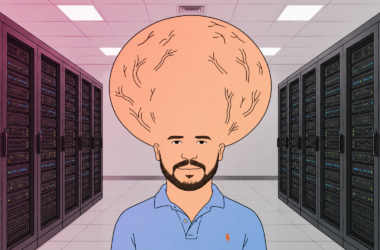



To mark the release of the second and final volume of the Spandrell translations, we went to meet him and ask him a few questions. True to form, Spandrell doesn’t mince words. Some of his answers might even run afoul of the law, so to avoid taking any chances, we’re making only part of our conversation public here. You can find the full interview at the beginning of Volume 02, available on our Tipeee.
NIMH: You’re famous for writing the essay Bioleninism, which argues that we’re seeing a left-wing singularity that resembles Leninism. To put it simply, Leninism gives power to people from the lower classes, while bioleninism gives power to people from a lower “biological background.” Do you think we’re seeing the end of this trend?
Spandrell: Well, ever since Trump’s victory in 2024, everyone’s been talking about a “change in the mood,” and you can definitely see it. It’s funny: the Democratic Party chose two white guys to lead its national committee. I don’t know if they’re straight or not, but it’s still notable that they didn’t pick AOC and some random Black woman.
The problem with choosing people for their loyalty rather than their competence is that… well, they aren’t competent. Kamala Harris’s campaign in the United States was a monumental disaster. Everyone’s wondering what happened to the left’s “energy.” These are the same people who terrorized the entire country in 2020 and literally made army officers kneel before a drug-addicted criminal named George Floyd. My personal theory is that the people who organized all that later got cushy jobs in the Biden administration and simply weren’t available to run Kamala’s campaign. It all comes down to logistics, you see.
So yeah, it looks like bioleninism has hit a wall, and left-wing parties are going to have to rebuild by putting a little more emphasis on competence and a little less on loyalty. And then there’s the fact that the latest addition to their coalition was trans men. There are two types: traditional homosexuals (like ladyboys) and, more recently, autogynephiles, whom my friends and I call “troons” (to distinguish them from gay trans people). And those people are seriously mentally ill, narcissistic, and unpleasant. By invading women’s sports and high school girls’ bathrooms, they somehow managed to alienate millions of middle-aged women. That’s my little theory about why Trump won.
N: You criticize bureaucracy and the expansion of the ruling class, while also saying democracy is a sham. Yet you don’t seem especially convinced by neocameralism, let alone Moldbug’s “patchwork.” In your view, what would be a better form of government?
S: Moldbug’s idea was to apply the legal structure of modern corporations to politics, and I don’t think it works because it doesn’t take violence into account. The business world is mostly about money; politics is about money and violence. A CEO with armed men under his command wouldn’t agree to be quietly fired by the board every time unless there were something beyond the mere letter of the law. That’s just the real history of monarchies, in practice. It doesn’t really work in the modern world. We had monarchies before, and they disappeared for a reason. Even in strange places where the monarchy has recently regained power, like Thailand, it’s not a very stable system.
What would be best… well, that’s a complicated question. There’s a tension here: empirically, the nation-state is the best at creating loyalty among large groups; but in today’s economy, it’s being eaten alive by international corporations with access to mercenary talent (I don’t mean that negatively; I’m one myself). And now AI is arriving as a new factor that’s going to change a lot of political dynamics, too.
My intuition is that there’s no institutional silver bullet for fixing governance in our world. As Churchill said, democracy may be the worst form of government, except for all the others that don’t work at all. The fact is, people are stupid; we have a hardware problem. I’m more interested in improving the population’s genetic stock, its hardware, than in trying to come up with yet another institutional software patch to keep our current humans going for one more day. Whatever love I had for the masses died completely after the COVID debacle.
N: You say you’ve lost faith in the power of debate and are skeptical about the impact bloggers and intellectuals have on society. But don’t you think we’re seeing the opposite today, with some people in power influenced by these NRx bloggers?
S: I’m not skeptical about the impact of good writing; I just see less of it these days. Twitter destroyed the blogosphere. Instead of thoughtful essays on personal blogs with a community of intelligent commenters, you get an arms race of trash memes on Twitter, posted by accounts with handles like NIGGER SLAYER RAPIST GROYPER and anime avatars, all trying to score some Elonbucks. I’m not entirely against it myself; I plead guilty. That’s just how things are. It’s also cool to see Curtis Yarvin in The New York Times or Steve Hsu reading my blog.
Maybe I just read less, and there’s great stuff on Substack that I’m missing, so maybe it’s just me. But I get the impression that the consensus among people drawn to neoreactionary stuff is that we’ve said all we can say and there’s nothing left to do. Anyway, as I said, we just need to make people smarter. At the very least, we’re all doomed if we don’t solve the birth-rate problem, and we still have no idea how to do that.
N: You criticize modern society’s obsession with equality and kindness. What values, in your view, should we prioritize to build a healthier, more sustainable society?
S: One thing that has always struck me is the transition from classical Europe to Christianity. Greece and Rome revered the Iliad, the cult of the warrior hero. Every kid in the Roman Empire was raised to worship Achilles and saw that as the true life of a man. The Vikings had a similar culture, where growing old instead of dying in battle was considered shameful. The Romans who saw pagan temples destroyed by an Eastern cult of equality, kindness, and submission must have thought it was completely insane.
But everything happens for a reason, and if you exalt the strong, the brave, the brilliant, and the beautiful, well, you make enemies of the weak, the cowardly, the stupid, and the ugly—and that’s a lot of people. Every society needs the support of a majority, so a simple cult of excellence (which seems obvious, since excellence is the best) is inherently unstable. All human cultures have been egalitarian in one way or another, whether in theory or through obscure practices (like the Law of Jante). That’s hard to pull off today, given what we know about genetics.
It’s a complicated question. One solution that worked well was to divide humanity into distinct groups and make them compete. Smart Germans and stupid Germans joined forces to fight smart Frenchmen and stupid Frenchmen, and that worked pretty well. But today there’s fast travel and the Internet, and smart Germans and smart Frenchmen would rather hang out together and speak English than spend time with their average compatriots.
As I said, the only thing that really matters in the end is the quality of the population’s genetic inheritance. So we need values that encourage people to aim for that, while giving you some leeway in the process. Think Gattaca, but done right. I don’t really know how to make that work; it’s a hell of a puzzle.
N: You know a lot about Asia and Asian cultures, since you’ve lived there. That’s something you have in common with Nick Land. Do you think neoreaction is a specifically Western movement, or could it apply to other cultures too? Is there anything the West can learn from Asia?
S: For the record, I still live in Asia, and I probably will continue to unless Europe has a real counterrevolution. Neoreaction is clearly a Western ideological movement. I’ve occasionally tried talking about it with Chinese and Japanese people (I speak their languages fluently), but they’re not interested. Asian intellectual culture is just extremely different. We have plenty of problems in common, like feminism, but they have their own movements to deal with that, which have nothing to do with the mountains of anti-feminist writing the West has been producing for decades. That’s just how it is, and the language barrier has very little to do with it. We just have different brain circuits.
I think we have a lot to learn from each other. I like living in Asia because I hate hypocrisy, and Western intellectuals are full of it, whereas the yellows don’t operate that way. But the yellows are a little lacking in initiative, and that’s something they could learn from us. I think it’s mostly genetic, so there’s little chance either side will change.
Overall, I still think they have the advantage. Even in Asia’s most deracinated countries, their ruling class had the decency not to fill their countries with the masses of the Global South, and that really does improve everyone’s standard of living. But then they let themselves be exploited, working 14-hour days for lousy pay, and that’s just sad.