

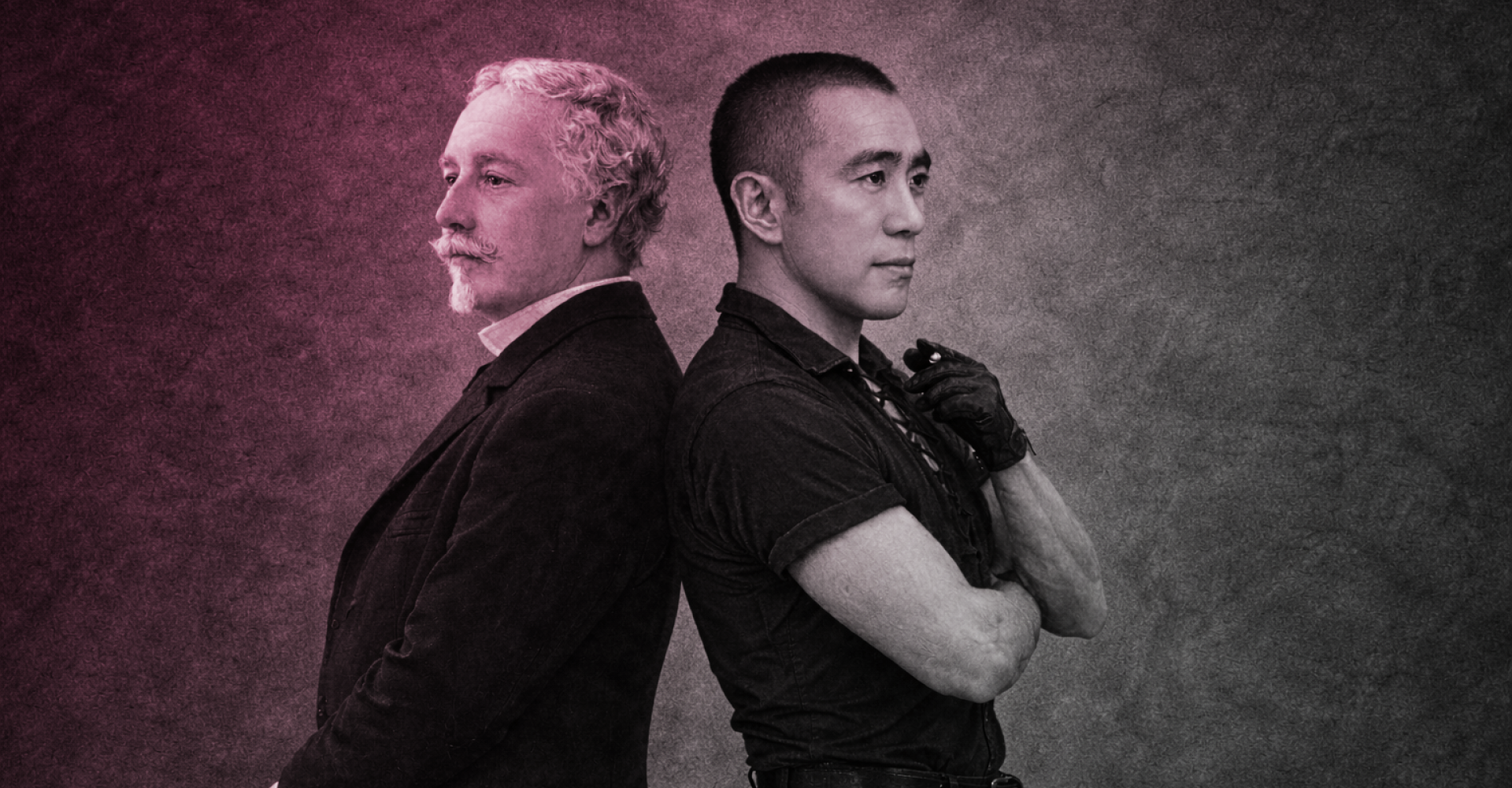

Writing about decadence has become bad form on the Right lately. Since the emergence—or rather, the re-emergence—of a progressive Right in Europe, it has become essential to avoid the subject for fear of scaring off the young.
Because yes, the Right used to be too anxiety-inducing, and it traumatized a generation of young activists—that’s what the fun Right says. I’ll pass over the irony of a denialism that sees its adherents as delicate little things. Still, I should point out that, in its latest incarnation, the progressive Right took the bull by the horns in a bold move that strikes close to my heart. Because, to me, fun cannot spring from a lie.
A good American, I am a Kamalist: I believe in joy. But I am a deviationist: I want a joy that comes through strength. And we cannot be strong by avoiding what frightens us—White Flight makes for beautiful neighborhoods… on the outskirts.
If we are to stop retreating, we must toughen up. And since travel broadens the mind, I invite you aboard my Nellie: let us sail into the dark heart of a deterministic and pessimistic vision of decadence; let us make landfall in Yukio Mishima and Arthur de Gobineau, as they reveal themselves in The Sea of Fertility and The Inequality of Human Races.
Fear nothing: words do not kill; decadence is an opportunity; the present must die for the future to be born; if you read about Europe, you could be arrested; one must learn to despair to the very end; one more step and we shall be masters.
Mishima and Gobineau
But before discussing tragedy, cycles, and the impoverishment of souls and races, let us be a little trad and briefly introduce the authors.
Mishima and Gobineau are paradoxically both well known and relatively unknown. Each man conceived a work so monumental that it obscures the rest of his oeuvre: the Essay for Arthur, the Suicide for Yukio. As for me, I prefer the book The Renaissance and the film Patriotism.
A clarification, in case it is not already too late to prevent misunderstandings: this text is not a review, a critique, or a summary. It is a thesis—and one I believe to be unprecedented!
Thanks to the tireless work of certain posters and video-makers, Yukio Mishima has regained a certain degree of notoriety. Yet there is always a risk in deciding to talk about Mishima: as with Nietzsche, one suddenly becomes suspect of adolescent immaturity and romantic attachments to violence. One can escape this dangerous suspicion by sticking to the aesthetic side of things.
But I earn no money from writing, so this tightrope act does not interest me. I wrote above that I love strength. Let us be strong: yes, I like muscles, and I support violence… when it is constrained by our democratic and humanist values.
But… I fear that I am talking about myself only to avoid discussing this Japanese writer. Am I a coward? Yes, I am afraid of this life. It is part of the work, but all too often it serves as a reason to admire him without reading him! Since it must be done…
It seems to me that I must first speak of a sickly child, shut away with an old woman and afraid of the sun—that is youth. Then, of a young man gifted in literature who betrays himself by feigning illness to avoid the war, and who fears steel—that is adolescence. Then, of a man, certainly a chiaroscuro figure, who overcomes himself, makes his peace with the sun and steel, and fears the death of his beauty—that is adulthood. Finally, still a man, who redeems himself through an act (this matters for what follows!) when faced with the decadence of a tradition he has betrayed, and who fears nothing anymore—that is the martyr.
As for Arthur de Gobineau, recipient of the Bordin Prize and immortalized in the Pléiade, there is no need to dwell on the risk. That one cannot harm an anon.
Providence ordained that he be born into a family of the nobility of the Ancien Régime—the Prophet of the disappearance of the great races is already taking shape. The son of a military man and a madwoman, the child would go into exile to escape the creditors and police pursuing his mother—the Germanophile appears; he will never leave. Back in France, as a young man enamored of literature and its glory, he makes his way to Paris—the Man of Letters begins; he will never live by it. A Legitimist, but a man must live, he joins Minister Tocqueville’s office and then the imperial diplomatic service. This is the brilliant dilettante, made firm by travel and the courts, able to afford the idleness required to live for his work—and therefore to infuriate the specialists, who make their living from theirs. And it continues, beyond the grave. Growing old and recalled at last, he finally breaks through, but… in Germany, through Richard Wagner—the assurance of posterity. Relatively distinguished, but still growing old; the defeat of 1871; the proclamation of the Republic; the end of his career and difficult final years—this is the end.
The novelist’s and short-story writer’s oeuvre stands on its own. Here is my prescription: Asian Novels, The Pleiads, and The Renaissance.
Now that the formalities are out of the way, let us hurry on!
The Sea of Fertility
The Sea of Fertility tetralogy is a series of novels spanning 1911 to 1970, set in a Japan that is more than a backdrop: it is a metaphysical character in the story. Spring Snow. Runaway Horses. The Temple of Dawn. The Decay of the Angel. Those are the titles! My thesis depends on this quartet representing Mishima’s literary testament. What the writer commits to it must therefore be taken seriously. If he did not compose it with his blood, he did at least sign it with that blood.
The novels follow Shigekuni Honda’s life, chiefly in his singular role as the axis around which his childhood friend Kiyoaki Matsugae’s reincarnations eternally return. Kiyoaki and his successive incarnations come to embody a kind of avatar of Japan—or at least an individual mirror of the Japanese collective.
Thus, Kiyoaki reflects Japan in the Taishō era, teetering between liberalism and authoritarianism: aristocratic, refined, beautiful, he possesses enormous innate potential, but also an indecision that leads him to inaction—at least until tragedy reveals him capable of riding his destiny to its darkest conclusion.
His second incarnation, Isao Iinuma, appears to us as a purified version of the first. This is the emerging Shōwa-era Japan. Reactionary, but partly freed from the constraints of caste; stripped of refinement, he is decisive to the point of violence. Rejecting the political realist’s calculus, he chooses Action as proof through beauty, and therefore as a source of salvation.
Then comes Ying Chan, the only incarnation to be a woman and not Japanese. She is cosmopolitan, murky to the point of passive dishonesty, and spiritually ambiguous, even emptied out. This is Shōwa Japan 2.0, emerging from the ruins under American occupation.
The case of Kiyoaki’s final incarnation is harder to resolve. Mishima brings in a theological layer to complete the cycle, one that will matter to the argument I shall make. But, for the sake of clarity, I will continue along my present line of thought and return to it later. Toru Yasunaga is beautiful, like all the preceding incarnations, but his beauty is without warmth. He is young, yet lacks youth’s plasticity. He is the coming Japan of the Akihito era; he is an ending without soul or nobility; he is completion.
We must acknowledge the successive decline of the incarnations whom Shigekuni Honda encounters over the course of his long life—though the conclusion may be more ambiguous in the case of Isao Iinuma, and will vary according to one’s judgment, especially given the sensibilities of Mishima’s readers. I differ from the writer in that the Laws of Manu hold only slight interest for me. Yet I share his belief in the possibility that a single soul might become progressively impoverished until it is annihilated—we see it every day. What matters here is the rather insoluble question Mishima confronts us with: do impoverished souls lead to the decadence of society? If so, what led to their impoverishment? Or is it the other way around, with a decadent society inexorably impoverishing souls, and thereby progressively losing the possibility of renewal?
Mishima seems to point toward a partial answer that is at once symbiotic and cyclical—and not universalist. Souls need the metaphysics of imperial Japan to maintain their standing, and imperial Japan needs souls that remain whole in order to function.
I now return to Toru Yasunaga and the theological element Yukio Mishima introduces: the Angels of Buddhism. They are beings superior to humans, though still imprisoned in the cycle of reincarnation. Like Spenglerian civilizations, they undergo organic cycles that culminate in their foretold death, announced by their physical decline—a decomposition that begins before the heart has stopped beating. Kiyoaki then takes on a broader significance as the incarnation of the Angel of the Japanese national genius, with each of his lives representing a phase in the cycle of that Angel’s life. With Toru, the cycle and the tetralogy come to an end. Does this death announce an ending or a renewal?
Let us leave that aside. The moment when we bring the works together is approaching, but it has not yet arrived…
The Inequality of Human Races
The Essay is a massive account of universal history that traces every people back to antediluvian races—yellow, black, and white. Arthur de Gobineau develops an almost alchemical theory of the morphology of civilizations’ development, progress, and decline, according to how much yellow, black, and white blood flows through a population’s veins.
In a more civilized age, one might greet it as an outdated but visionary work. But we do not live in such an age.
It is read mainly as a means of attacking an absent father of Nazism. People dwell on the biblical references to the origins of peoples, the chapter devoted to phrenology, the attributes of the races, and a few bold linguistic hypotheses—when they are not simply inventing passages.
For my part, I smiled as I read these chapters. I consider that a good thing, not a failing. I also recognized the speculative imagination of the great nineteenth-century historians, which archaeogenetic studies are now bringing back from purgatory, like devils popping out of their boxes. And I sensed such force beneath these ideas that, if taken seriously, they would bring about a transvaluation of values as radical as the conversion of the ancient world to Christianity.
If they read it, even superficially, they would stop smiling—and they have already stopped… For Gobineau leaves nothing untouched; he spares nothing. In his search for the Meaning of History, he sets out to demolish the commonplace assumptions that prevent thought on both the Right and the Left—and this is probably where reading him is most rewarding.
To demolish the universalist Left’s unassailable Rousseau-Hugo cliché that institutions make people, Gobineau offers readers an instructive portrait of Haiti’s ruling class. It exalts the same progressive idols as its enlightened European counterparts. Its regime is republican, built on the same philosophical and political foundations as the American and French republics. And yet Haiti remains a voodoo hell—and our contemporary attempts to relocate its citizens seem likely to run up against the same limits…
On the Right, he topples the eternal golden calves that every connoisseur of decadence expects to find in a work on the subject: the decline of civic values and religiosity among populations of native descent.
For, indeed, they point out quite rightly that periods of ascendancy in a people’s history rarely coincide with periods when public morality is at its highest. American power truly takes off during the age of the Robber Barons and the Roaring Twenties, not during the Salem witch trials or the first Thanksgiving of the Mayflower Pilgrims. Can we really speak of lofty civic virtue when Romulus abducts the Sabine women? And yet this is surely a consequential founding act.
On the decline of religiosity as a sign of decadence, this practicing Catholic has no hesitation in asserting that, at the time of Rome’s Fall, no one can doubt the strength of its inhabitants’ religious practice or the sincerity of their faith… So what could have changed?
…Geography?
Oh, yes! He also dismantles Montesquieu’s geographical determinism, but since that is now accepted on both the Left and the Right, let us move on…
No, for Gobineau the only explanation is that the ethnic composition of a people changed between the period of its founding and its decadence. Peoples are first founded through the union of conquering and conquered races. A white people—for none of the other races, in his view, can found a civilization—conquers another black or yellow people, settles there permanently, and forms a new elite and a new system of government. Then, faced with the disproportionate mass of those it governs, it interbreeds and enters into decline.
Before the arrival of the first legal or illegal migrant, the game is already lost: the masters sleep with the servants, and their descendants are already different.
This cycle is inescapable. It can only be tempered either by an implacable system of government that prohibits intermixture, such as Brahmanism, or by the arrival of a fresh influx of white blood, as in the Völkerwanderung. It is worth noting that, in the Count’s view, his contemporaries in Europe were no longer pure Whites, but were mixed to varying degrees. What would he write today if he could be introduced to the leaders of the Alt-Right or the Identitarians?
Here, then, we have a universal theory of history, conceived by a writer with not one atom of democracy or universalism in him. But is that not the genius of literature: to arrive at the universal by starting from the particular?
At last, we reach our destination: the place where these two great works converge.
Cycles: Metempsychosis, Races, and Decadence
To recap, we have brought to light two cyclical visions of the decadence of peoples. The first is metaphysical: it begins at an uncertain point and manifests itself in the deterioration of souls through the cycle of transmigration. The second is biologizing: it begins with the first acts of intermixture and manifests itself in the ever-widening gap between a founding people and its descendants, who mutate into genuine strangers to the fundamental principles they no longer understand.
But if we examine these two approaches more closely, it soon becomes clear that their causes differ only on the surface. In both theories, the prime mover is an alteration in the underlying population—whether its source is an influx of yellow or black blood, or the Laws of Manu and Shinto-Buddhist traditions.
The taxonomies circulating online might tend to label the Count’s vision “identitarian,” and a certain brand of internet stupidity might even reach for the dirty word “libertarian.” Meanwhile, Yukio Mishima’s approach might seem to tend toward Eastern state authoritarianism. But once again, that would be superficial. If the ideology of imperial worship is connected to the preservation or deterioration of souls, the author never states this directly; only some of his characters do. In this respect, his view is not far removed from the role Arthur de Gobineau assigns to certain enlightened states, which enacted political and religious laws to obstruct or prevent the alteration of their ruling class. In the end, in both cases, the State ceases to perform its sacred role because the population is no longer the same. In both cases, we find a mass clamoring for change—and, ironically, this leads to socialism, both in the Shōwa 2.0 of The Temple of Dawn and in late nineteenth-century Europe and our own time: the immortal cry of decadent souls and races.
Yet a major point of divergence emerges, and it will prove more interesting than all the common ground: the irreversibility of the process of decadence—or, in other words, the degree of pessimism in the thought of the two writers.
As the chapter on phrenology shows, the Count lived in an age when the scientific method was still in its infancy, far removed from the new possibilities it would open to the world. His thought therefore goes beyond pessimism and sinks into fatalism: intermixture cannot be undone once it has taken place. This was reinforced by the fact that the Western historical world was already on the threshold of old age, while almost the entire globe was being explored and mapped and its peoples systematically classified. There were no White Peoples left to replenish the stock of greatness.
For Mishima, pessimism is also present, but it is made ambiguous partly by the novel form, by the metaphysical assertion of metempsychosis, and especially by the assertion that salvation is possible through the pure Act. But there is a problem: Isao, the only character to attempt this Act and achieve an aesthetically perfect execution, fails to halt Japan’s decadence—quite the opposite! To take this further, I must overcome my revulsion and speak of Mishima’s own life and his own Act, whose execution fell far short of aesthetic perfection. Here, too, seppuku did not halt Japan’s decadence—this time, the decadence of Japan outside literature. Yet we are led to believe that, if the writer attempted this Act, it was because he honestly believed the decadence of individual souls and the collective soul could be reversed through Action—and men are always honest… Mishima’s overcoming of decadence took the form of an active nihilism, which implies preferring duty to life, not necessarily believing in a path to collective salvation.
Perhaps the real difference between Gobineau’s and Mishima’s visions comes down to a question of faith. The first, a devout Catholic, can accept that the most beautiful races must disappear, that civilizations cannot be saved, because at the end of everything there will be the Last Judgment, the Parousia, and eternity spent in bliss in the company of the Good Lord. The second, with his eclectic procession of a sacred Emperor, a Peacock King, Shinto-Buddhism, Indian amalgams, and nationalism, cannot accept decadence, because he will have to live through it as it sinks ever lower—the Eternal Return without Amor fati…
Conclusion
For us, living in the era of Naruhito/Ano Domini 2025, it is not enough to stupidly deny the existence of decadence. Whether we are biologizing materialists or spiritualists of metempsychosis, the question of decadence and its reversibility must concern us, and seriously… because the stakes are… serious—perhaps even more than that. At the very least, we should make sure that the answers we attempt, and the results we want, are ones we can live with.
Alas, the answers given by Mishima and Gobineau can no longer satisfy us! The gods no longer walk the earth. So Gobineau’s Christian expectation of an inevitable defeat followed by an equally inevitable final triumph cannot be offered to young people who no longer believe in God—and even if they did believe, we would have to force them not to accept it! …And so, in this disenchanted world, Mishima’s active nihilism would be no more than a mechanical imitation… negative advertising for suicide-prevention hotlines.
And yet we have the advantage of standing on heights of scientific and technical knowledge neither of our two authors could have glimpsed—not even the one who witnessed the Atom unleashed by man against man. Already, we sense the ascent toward the next summit. Higher still. And if vertigo seizes us, then let it forbid us ever to descend again!
This is not entirely new—but apart from the thesis of this text, nothing ever is. Gobineau’s heirs tried to use Science and Technology to stem his prognosis, in such a way that they permanently disgusted subsequent generations with them. But today, we no longer need the methods of the past; we now have gentle medicine. Parents are already flocking to select and thus improve the fetus of their future child; competition in the techno-capitalist world will drive ever more of them to do so. And the beauty of decadence lies in the way it strips away the options until only one remains: overcome it or disappear.
Mishima’s seppuku did not stop Japanese decadence from continuing its inexorable course, but his work may have enriched some souls. Was his suicide anything other than the crowning achievement of that work? At first it was greeted with mockery, but over time that mockery was spat back out of its stinking mouth, and no one laughs anymore. That is how myths are born, I believe.
It may be that the impoverishment of souls was caused only by their limited number, and that, to compensate for the exponential growth in human beings, we had to divide them into fragments. If the global population figures are anything to go by, this too is being resolved amid full-blown decadence.
Perhaps we can already see the golden light that tells us we are approaching the exit from the Kali Yuga… Perhaps the Franks will emerge again from the forests of Franconia…
Perhaps, for that to happen, billions must … but:
“I’ve just had a dream.
I will see you again.
I know it.
Beneath the waterfall.”
—Yukio Mishima, Spring Snow